Onion juice can plausibly support eyebrow regrowth, but the honest answer is that the evidence is limited and indirect. The only controlled human trial on topical onion juice and hair loss used it on scalp alopecia areata, not eyebrows, and found that 87% of participants showed regrowth after six weeks of twice-daily application. No equivalent trial exists for brows specifically. That said, the biological mechanisms are credible enough that trying onion juice is reasonable as a low-cost adjunct, as long as you use it carefully, dilute it properly, and keep it well away from your eyes.
Can Onion Juice Grow Eyebrows? Evidence, Safety & How-To

James Whitmore
7 Aug 2026
How onion juice might stimulate eyebrow hair
There are three main pathways researchers point to when explaining why Allium cepa extracts might influence hair follicles, and none of them require you to take anyone's word for it on faith alone.
Sulfur compounds and follicle nutrition
Onions are dense in organosulfur compounds, specifically alk(en)yl cysteine sulfoxides that break down into reactive sulfur species when the onion tissue is crushed. Sulfur is a structural component of keratin, the protein that makes up hair. The logic is that topical sulfur delivery could support follicle function and hair shaft integrity. Preclinical studies on Allium hookeri and Allium tuberosum extracts (close relatives of the common onion) found increased dermal papilla cell viability and upregulated growth factors including IGF-1 and VEGF in follicle models. These are the same growth factors that play a central role in moving follicles into the anagen (active growth) phase.
Antioxidant activity
Onions are also rich in quercetin and other flavonoids with documented antioxidant properties. Oxidative stress at the follicle level is associated with premature follicle miniaturization and telogen entry. Reducing that stress topically is a plausible, if modest, way to create a better environment for existing follicles to stay in the growth phase longer.
Mild irritation and increased blood flow
This is where it gets a bit counterintuitive. The same volatile sulfur compounds that make you cry when you chop an onion (propanethial S-oxide, produced by the alliinase enzyme system) are mild irritants that cause local vasodilation when applied to skin. Increased perifollicular blood flow matters because follicles are metabolically hungry during anagen. This is also part of how minoxidil works: it increases VEGF expression and local perfusion around follicles. Onion juice won't do this as reliably or as potently as minoxidil, but the mechanism isn't implausible. The catch is that too much irritation becomes counterproductive, which is why dilution and patch testing matter.
What the evidence actually shows
I want to be straightforward about the state of the science here, because there is a lot of overclaiming on this topic in the wellness space.
The one solid human trial
The most-cited study is a 2002 randomized controlled trial by Sharquie and Al-Obaidi published in the Journal of Dermatology. They enrolled 38 patients with patchy alopecia areata of the scalp: 23 applied crude fresh onion juice twice daily, and 15 applied tap water as a control. A randomized, placebo‑controlled trial (Onion Juice (Allium cepa L.), a new topical treatment for alopecia areata, The Journal of Dermatology (Sharquie & Al‑Obaidi, 2002)) tested fresh onion juice twice daily in 23 patients versus tap water in 15 controls and found regrowth in 86.9% of the onion group by six weeks versus 13% of controls (P<0.0001) Onion Juice (Allium cepa L.), a new topical treatment for alopecia areata — The Journal of Dermatology (Sharquie & Al‑Obaidi, 2002). By six weeks, 86.9% of the onion group showed terminal hair regrowth compared to 13% in the control group. That is a genuinely striking result for a simple home remedy. However, there are important caveats: the study involved scalp alopecia areata (an autoimmune condition), not the kind of eyebrow thinning most readers are dealing with, the sample size was small, and no one has replicated it at scale on brow hair specifically.
Preclinical and in vitro data
In vitro studies on related Allium species show real hair-inductive effects in dermal papilla cell cultures and mouse models, including upregulation of IGF-1, VEGF, and FGF-family signaling. These are mechanistically meaningful results. But cell culture and mouse models are a long way from a clinical recommendation, and formulations tested in labs are usually standardized extracts, not the raw juice you press at home.
Anecdote versus evidence
The vast majority of eyebrow-specific claims come from personal testimonials, beauty blogs, and social media. These are not worthless (lived experience is real data), but they suffer from obvious confounders: people doing multiple things at once, brows that would have recovered naturally anyway, and heavy reporting bias toward success stories. I treat anecdotal evidence as hypothesis-generating, not confirmation. The honest summary is: biologically plausible, one encouraging small human trial in a related condition, no controlled eyebrow-specific data. That puts onion juice in the "worth trying carefully" category, not the "proven treatment" category.
Safety first: protecting your eyes and skin
This section matters more than most people realize. Onion juice near the eye area is not a trivial risk. The same volatile compounds responsible for any potential growth effect are also potent ocular irritants. Fresh onion juice that contacts your conjunctiva can cause chemical irritation, excessive tearing, and in the worst case, corneal injury. Clinicians actively discourage placing unsterile plant juices in or directly on the eye, and animal model studies on periocular Allium exposure show a real irritation potential. Here is how to stay safe.
- Patch test before any facial application: apply a small amount of diluted onion juice to the inside of your forearm, leave it for 20 minutes, then rinse. Wait 48 hours and check for redness, swelling, or itching. If you react, do not apply it to your face.
- Always dilute: never apply raw undiluted onion juice directly to your brow area on the first use. Start with a 1:3 ratio (one part juice to three parts carrier oil such as jojoba or coconut oil) and work up gradually if no irritation occurs.
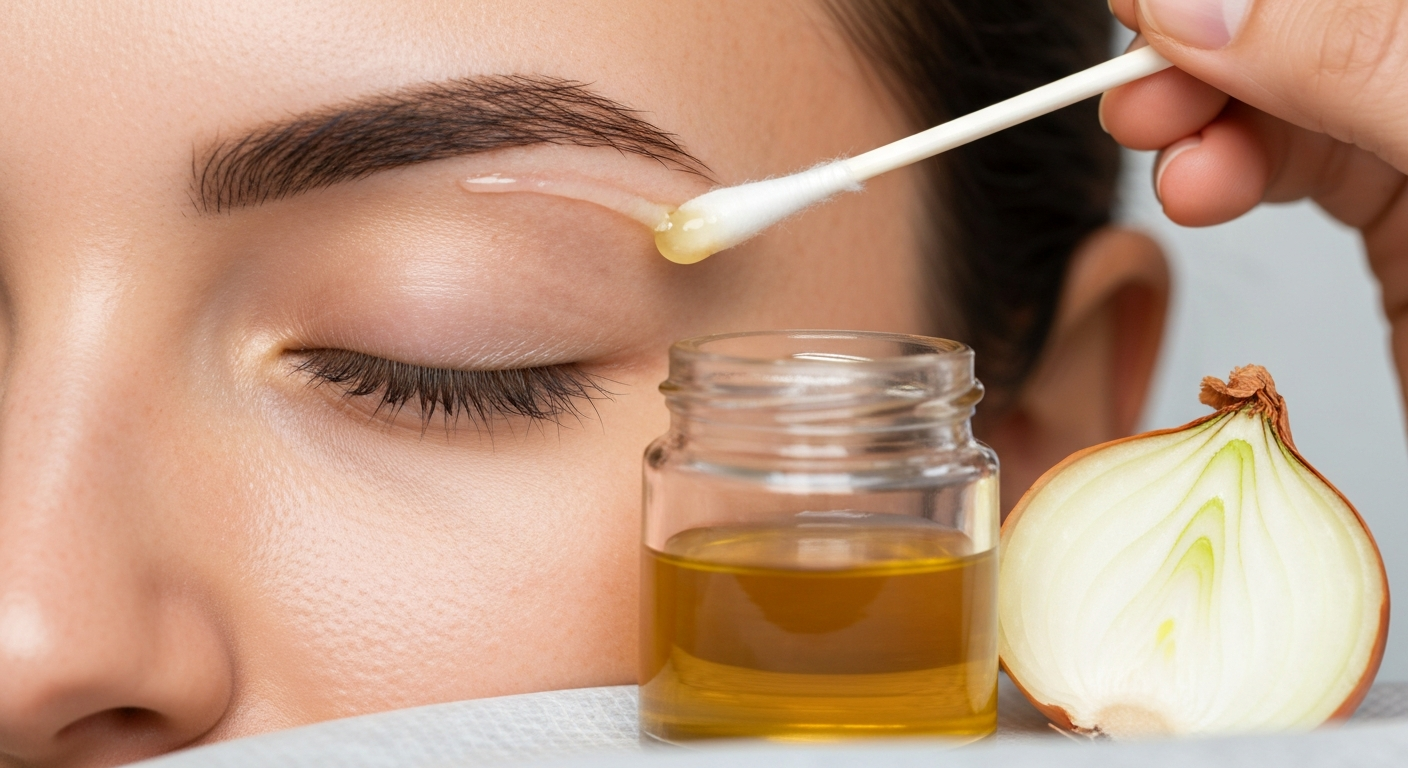
- Use a fine-tip cotton swab or a clean spoolie brush to apply precisely along the brow line only, not on the eyelid skin or near the lash line.
- Keep your eyes closed during application and for 2 to 3 minutes afterward. Do not rub your eyes.
- Avoid application right before bed if you roll onto your face or rub your eyes in your sleep. A short contact time (15 to 30 minutes) followed by rinsing reduces eye-exposure risk.
- Never apply to broken skin, active dermatitis, or skin with open wounds.
- Stop immediately if you experience redness that does not resolve within a few hours, swelling, burning that persists, or any eye pain.
Step-by-step application methods
There are two main approaches: fresh juice applied with a swab versus an oil infusion used as a serum. Each has trade-offs in potency, convenience, and safety margin.
Method 1: Fresh juice with a cotton swab (higher potency, more caution needed)
- Peel and finely grate or blend a small piece of yellow or red onion (about a tablespoon of pulp). Yellow onions are highest in quercetin; red onions are a close second.
- Strain the pulp through a fine mesh strainer or cheesecloth, pressing firmly to extract juice. You need only 1 to 2 teaspoons per session.
- Mix the fresh juice with an equal volume of a carrier oil (jojoba, castor, or coconut oil) to create a 1:1 dilution. For a gentler start, use a 1:3 ratio.
- Dip a fine-tip cotton swab into the mixture. Apply with short strokes along the brow line, following the direction of hair growth, staying at least 5 mm away from the eyelid margin.
- Leave on for 15 to 30 minutes. Do not go overnight on your first uses. Sit upright or reclined (not lying fully flat) to reduce drip risk toward the eyes.
- Rinse with cool water and a gentle cleanser.
- Apply once daily in the evening, 4 to 5 times per week. Give your skin two days of rest.
Method 2: Oil infusion (gentler, easier to use, better for sensitive skin)
- Slice 1 medium onion and place in a clean glass jar. Cover completely with a carrier oil of your choice (castor oil for added thickness, jojoba for lighter skin feel).
- Seal and leave at room temperature for 48 to 72 hours, or refrigerate for up to one week. The oil draws out fat-soluble compounds from the onion.
- Strain out the onion pieces completely. Store the infused oil in a dark glass bottle in the fridge for up to two weeks.
- Apply a tiny amount (2 to 3 drops per brow) with a clean spoolie brush or fingertip along the brow line each evening.
- This can be left on overnight if you have confirmed no irritation via patch testing, since the dilution in oil significantly reduces the volatile compound concentration.
Rubbing versus applying with a swab
Some sources recommend rubbing a cut onion directly on the brow area. If you’re wondering “does rubbing onion help eyebrows grow,” the evidence is limited and suggests only a modest possibility of benefit while increasing the risk of eye irritation, so precision application methods are safer. I would steer away from this method for the brow specifically. You have much less control over where the juice goes, the mechanical friction can irritate already-thin brow skin, and the juice is far more likely to run toward your eyes. A cotton swab or spoolie gives you precision. The rubbing approach might be explored more in the context of other application styles, but for brows, precision wins over intensity every time.
DIY recipes with exact measurements
Recipe 1: Basic fresh onion juice blend
- 1 teaspoon freshly strained onion juice
- 1 teaspoon jojoba oil
- Mix in a small clean dish. Use immediately. Do not store; prepare fresh each session.
Recipe 2: Gentle starter dilution (for sensitive skin or first week of use)
- 1 teaspoon freshly strained onion juice
- 3 teaspoons coconut oil (melted) or jojoba oil
- 1 to 2 drops lavender essential oil (optional, mild antimicrobial, partially masks odor)
- Mix and apply with a swab. Leave on for 20 minutes, then rinse.
Recipe 3: Overnight oil infusion serum
- 1 medium yellow onion, thinly sliced
- 60 ml (4 tablespoons) castor oil
- 20 ml (about 4 teaspoons) rosemary-infused oil or plain jojoba oil
- Combine in a sealed glass jar. Infuse at room temperature for 48 hours. Strain thoroughly. Store refrigerated in a dark bottle.
- Use 2 to 3 drops per brow with a clean spoolie each night. This recipe combines onion's potential sulfur and antioxidant activity with castor oil's occlusive conditioning and rosemary oil's own evidence-backed follicle stimulation.
Recipe 4: Nightly brow serum with multiple actives
- 2 teaspoons onion-infused castor oil (from Recipe 3)
- 1 teaspoon amla oil (adds additional antioxidant and conditioning benefit)
- 2 drops rosemary essential oil (diluted to roughly 0.5% in total volume)
- Apply nightly using a fine-tip spoolie, focusing on sparse areas within the brow line. This is not a recipe to apply to eyelids or lash lines.
Troubleshooting: when things go wrong
Most problems with onion juice are predictable and avoidable, but it helps to know what to watch for.
| Problem | Likely cause | What to do |
|---|---|---|
| Persistent redness or burning at brow site | Too-high concentration or sensitive skin | Increase dilution ratio to 1:4 or switch to oil infusion only; apply every other day |
| Eye stinging during or after application | Juice migrating toward eye or volatile compounds off-gassing | Reduce contact time to 10 minutes, use less product, keep head upright, switch to infused oil |
| Skin peeling or flaking at brow area | Irritant dermatitis from repeated sulfur exposure | Stop for 1 week; resume only with heavily diluted infusion or discontinue entirely |
| Allergic contact dermatitis (swelling, hives, intense itch) | True allergy to Allium compounds | Discontinue immediately; if swelling is significant, seek medical attention |
| Strong smell that lingers | Volatile sulfur compounds absorbing into skin | Rinse thoroughly after contact time; add a drop of lavender or tea tree oil to the blend; apply in the evening only |
| No visible change after 10 to 12 weeks | Remedy may not be sufficient for your type of thinning, or concentration is too low | Reassess: add rosemary oil, consider minoxidil, or consult a dermatologist to rule out medical causes |
| New bald patches appearing | Could indicate alopecia areata or another medical condition | Stop all home remedies and see a dermatologist; this is not a situation for self-treatment escalation |
Realistic timelines for eyebrow regrowth
This is where I see the most disappointment from people who try home remedies: unrealistic expectations about speed. Eyebrow hairs have a much shorter anagen (active growth) phase than scalp hair, roughly 2 to 3 months compared to several years for scalp hair. This means the anagen window is narrow and a smaller percentage of brow hairs are actively growing at any given time. The biology caps how quickly any remedy, including clinical ones, can work.
| Timeline | What to realistically expect |
|---|---|
| Weeks 1 to 2 | No visible change. This is when hair follicles, if responding, may be transitioning. The Sharquie trial noted regrowth beginning around week 2, but this was scalp AA under controlled conditions. |
| Weeks 3 to 6 | Very fine, possibly lighter vellus hairs may become visible in sparse patches if follicles are responding. Do not expect thick terminal hairs yet. |
| Weeks 8 to 12 | For mildly thinned or post-plucking brows, visible improvement in density is a realistic goal. Severely damaged or long-dormant follicles may take longer or may not respond to home remedies alone. |
| Months 4 to 6 | A full assessment window for any topical home remedy. If you have seen no meaningful change by month 4 with consistent use, escalate to a clinical option or get a professional evaluation. |
| Clinical treatments (minoxidil, bimatoprost) | Typically show measurable results in 12 to 16 weeks with consistent use; full effect assessment at 6 months. |
One thing that frustrates me about most timelines I read online is that they never mention what "working" actually looks like. Expect subtle changes first: slightly less sparse appearance in your lightest areas, finer new hairs at the front or tail of the brow, less visible skin through the arch. Full restoration of severely over-plucked or medically thinned brows via home remedies alone is uncommon. That is not pessimism; it is setting you up to make good decisions about when to seek additional help.
Clinical alternatives and how they stack up
Onion juice belongs in a broader toolkit. Here is how the main options compare, what the evidence says for each, and how to layer them safely.
| Treatment | Evidence level (eyebrows) | Primary mechanism | Best for | Key caution |
|---|---|---|---|---|
| Topical minoxidil (2% or 5%) | Strongest: RCTs support eyebrow use | Vasodilation, VEGF upregulation, prolongs anagen | Significant thinning, alopecia areata, androgenic loss | Avoid eye contact; wash hands after use; may cause initial shedding |
| Rosemary oil | Moderate: one RCT showed comparable results to 2% minoxidil for scalp AA; limited brow-specific data | Inhibits 5-alpha reductase, increases circulation | Mild to moderate thinning; good add-on to castor or onion oil | Use at 0.5 to 1% dilution to avoid irritation |
| Castor oil | Low: mostly anecdotal for hair; strong skin conditioning data | Occlusive barrier, ricinoleic acid may have anti-inflammatory action | Dry, brittle brow hairs; poor skin barrier at brow site | Can clog follicles if overused; use a pea-sized amount only |
| Amla oil | Low to moderate: Ayurvedic tradition + some in vitro antioxidant and 5AR inhibition data | Antioxidant, vitamin C precursor support, possible 5AR inhibition | Oxidative-stress-related thinning; good blending oil for serums | Generally well tolerated; confirm no nut allergy if in a blend |
| Batana oil | Very low: mostly traditional use, limited peer-reviewed study | Vitamin E, oleic acid, antioxidant; presumed occlusive/conditioning | General brow conditioning; texture improvement | Little clinical evidence; choose as a carrier/conditioner, not a standalone growth agent |
| Bimatoprost / latanoprost (Rx) | Strongest for eyebrow and eyelash growth specifically | Prostaglandin analogue: shifts follicles into anagen, increases pigmentation | Clinically diagnosed hypotrichosis, medical-grade thinning | Prescription only; can cause iris pigmentation changes; not a home remedy |
How to combine these safely
Stacking too many actives at once is a common mistake. If you are using onion juice (either fresh-juice blend or oil infusion), you can safely combine it with castor oil and amla oil in the same serum, since they are all carrier-type ingredients with complementary mechanisms and no known interactions. Adding rosemary essential oil at 0.5% concentration in the total blend is also reasonable. What you should not do is apply a rosemary essential oil concentrate directly, run onion juice alongside a prescription prostaglandin analogue without telling your dermatologist, or use minoxidil and strong onion juice simultaneously on the same skin until you have confirmed your skin tolerates each one separately. If you start minoxidil, I would pause the onion juice for the first four weeks, let your skin acclimate, and then reintroduce the onion infusion oil as a conditioning layer underneath the minoxidil solution if your skin is not irritated.
When to see a dermatologist or trichologist
Home remedies are appropriate for mild to moderate thinning from overplucking, post-waxing recovery, or general low density with no underlying medical cause. But eyebrow thinning can be a symptom of several conditions that will not respond to any topical remedy: alopecia areata, frontal fibrosing alopecia, hypothyroidism, telogen effluvium from nutritional deficiency, or trichotillomania. The review 'Eyebrow and Eyelash Alopecia: A Clinical Review, PMC (2023)' summarizes common dermatologic causes (alopecia areata, telogen effluvium, hypothyroidism, frontal fibrosing alopecia, nutritional deficiency, trichotillomania) and advises diagnosis-guided referral and therapy rather than empirical topical home remedies alone Eyebrow and Eyelash Alopecia: A Clinical Review — PMC (2023). The signs that tell me someone needs a professional evaluation rather than another DIY recipe include: sudden or rapid thinning that appeared over weeks rather than months, patchy loss with well-defined edges, thinning of the outer third of the brow (which can be associated with thyroid dysfunction), any associated scalp or skin changes, and thinning that does not respond at all after three to four months of consistent home treatment. A dermatologist or trichologist can run appropriate labs, perform a dermoscopy assessment, and recommend prescription treatments if needed. Getting that diagnosis early almost always leads to better outcomes than months of self-treating a condition that needs medical intervention.
The bottom line on onion juice for eyebrows
Onion juice has enough biological credibility and one decent human trial (in a related condition) to make it a reasonable low-cost thing to try if your brow thinning is mild and you apply it safely. For information on batana oil as an alternative, see our guide on whether will batana oil grow eyebrows. For step-by-step instructions on how to grow eyebrows with onion, see the guide on practical application and safety. Related: see our article on does garlic grow eyebrows for a discussion of a similar home-remedy approach. It is not a proven eyebrow treatment, and it will not outperform minoxidil or bimatoprost for significant hair loss. The risks are manageable with dilution and precise application, but the eye-proximity demands real caution. My honest recommendation: start with the overnight oil infusion recipe (Recipe 3), give it 10 to 12 weeks of consistent nightly use, and combine it with rosemary oil and castor oil. If you are not seeing any change by week 12, that is your signal to move to a clinically supported option or get a professional opinion. Realistic, consistent effort over months is how brow regrowth happens, regardless of which remedy you choose.
FAQ
Short answer: can onion juice grow eyebrows (or does rubbing onion help eyebrows grow)?
Short answer: Possibly — onion juice has biological plausibility and some human evidence for stimulating hair regrowth in patchy alopecia on the scalp, but there are no high‑quality clinical trials specifically for eyebrow regrowth. Anecdotes and limited studies (on scalp alopecia areata) suggest fresh onion juice can stimulate hair in some people, but results are variable and there are safety risks (eye irritation, allergic reaction, infection). Use cautiously and follow safety guidance, or choose established eyebrow treatments when appropriate.
What mechanisms could make onion juice affect hair/eyebrow growth?
Plausible mechanisms: 1) Organosulfur compounds in onion (alk(en)yl cysteine sulfoxides) may alter local follicle biology. 2) Preclinical studies report Allium extracts can up‑regulate growth factors (IGF‑1, VEGF) and support dermal papilla cell viability, which can encourage anagen entry. 3) Mild local irritation or increased blood flow (vasodilation) can secondarily stimulate follicles (mechanism invoked for other topicals). 4) Antioxidant/antimicrobial effects could support a healthier follicular environment. Note: these are biologically plausible pathways supported by lab/animal data and limited human evidence for scalp alopecia, not definitive proof for eyebrows.
What does the scientific and anecdotal evidence say?
Evidence summary: - Clinical: A randomized placebo‑controlled trial (Sharquie & Al‑Obaidi, 2002) found fresh onion juice applied twice daily produced hair regrowth in many patients with patchy scalp alopecia areata versus water. That trial used crude fresh onion juice on the scalp, not eyebrows. - Preclinical: Cell and animal studies show Allium extracts can increase growth‑factor expression and follicle cell proliferation. - Eyebrow‑specific: No randomized trials specifically for eyebrow hypotrichosis were identified. - Anecdote: Many people report eyebrow improvement, but anecdotal reports are subject to bias and variable preparation. Conclusion: evidence is suggestive but limited and not conclusive for eyebrow use.
Is applying onion juice near the eyes safe? What are the main risks?
Main safety concerns: - Eye/ocular irritation from volatile onion compounds (propanethial S‑oxide) — stinging, tearing, conjunctival irritation. - Corneal irritation or chemical injury if juice contacts the ocular surface. - Allergic contact dermatitis or irritant dermatitis on eyelid/skin. - Infection risk from unsterile homemade preparations. Clinicians generally advise against putting unsterile plant juices directly into or onto the eye. For eyebrow application, avoid lash/eye contact, dilute or use lower‑risk preparations, and stop if irritation occurs.
How to patch‑test and reduce risk before trying onion juice on eyebrows?
Patch‑test and safety steps: 1) Prepare your intended formulation. 2) Apply a small amount to an inconspicuous skin area (behind the ear or inner forearm) once daily for 3–7 days (open test) or use an occlusive patch and read at 48–72 hours for formal patch testing. 3) Watch for redness, itching, swelling or blistering. 4) If any irritation occurs, do not use near the eyes. 5) Keep eyes protected during use (look down, close eyes, use cotton swab) and wash immediately if stinging or tearing occurs.
Step‑by‑step safe application methods for onion juice to the eyebrow area
Two practical methods: A) Short‑contact fresh onion juice (safer for sensitive periocular skin): 1) Make fresh juice (see recipes). 2) Dilute 1 part juice : 2–3 parts sterile water or distilled witch hazel. 3) With eyes closed and head tilted back, use a cotton swab to apply a thin line over the eyebrow hairs and skin only — avoid lashes and lid margin. 4) Leave for 10–30 minutes, then rinse thoroughly with cool water. 5) Use once daily, 3–5 times per week. B) Overnight/in‑oil infusion (less irritant, slower): 1) Make an infused oil (onion + carrier oil) or use a diluted extract in oil (recipes below). 2) Apply with a clean spoolie along brows avoiding lash line. 3) Leave overnight or 6–8 hours and wash off in the morning. 4) Use 3–5 nights per week. Always patch‑test first and stop with any irritation.
Next Article
Does Vitamin E Oil Help Eyebrows Grow? Safe Routine & Timeline
Find out if vitamin E oil helps eyebrow growth, plus a safe routine, timelines, and what works better.