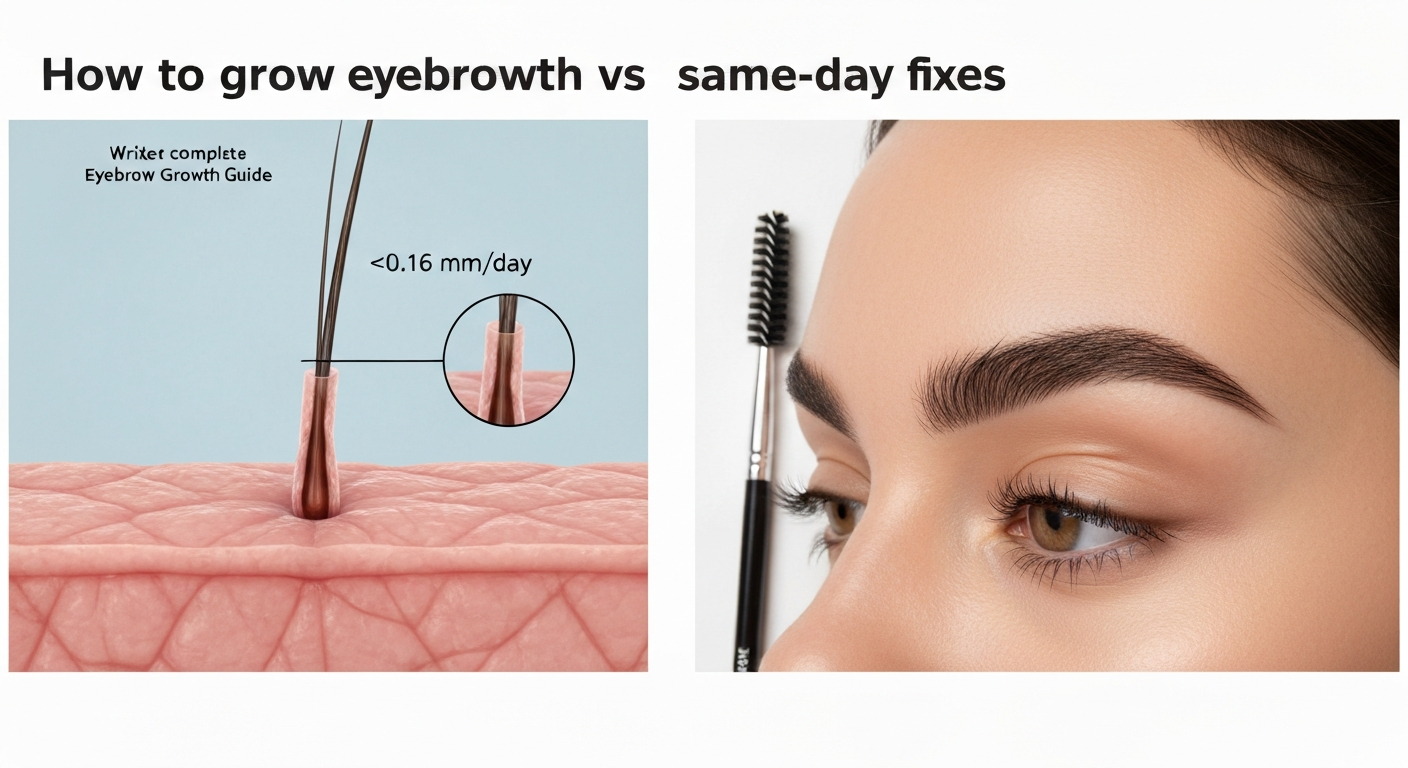
You cannot grow measurably thicker eyebrows in 10 days. Eyebrow hairs grow at roughly 0.12 to 0.16 mm per day, and even a follicle that starts waking up today won't produce a visible hair above the skin surface for several weeks. Measured growth rates differ by site: published reviews report scalp hair ≈0.3–0.36 mm/day, while eyelash/eyebrow growth rates are lower (~0.12–0.16 mm/day), so expect only a few millimetres of new brow length per month under optimal conditions (Anatomy, Hair - StatPearls). What you CAN do in 10 days is create the best possible biological conditions for regrowth, start the topicals that take months to pay off, and use cosmetic tools to look like you have fuller brows right now. That combination, done consistently, will produce real visible improvement by day 10 and set you up for genuinely significant change by the four to eight week mark.
How to Grow Eyebrows in 10 Days: Fast, Realistic Plan
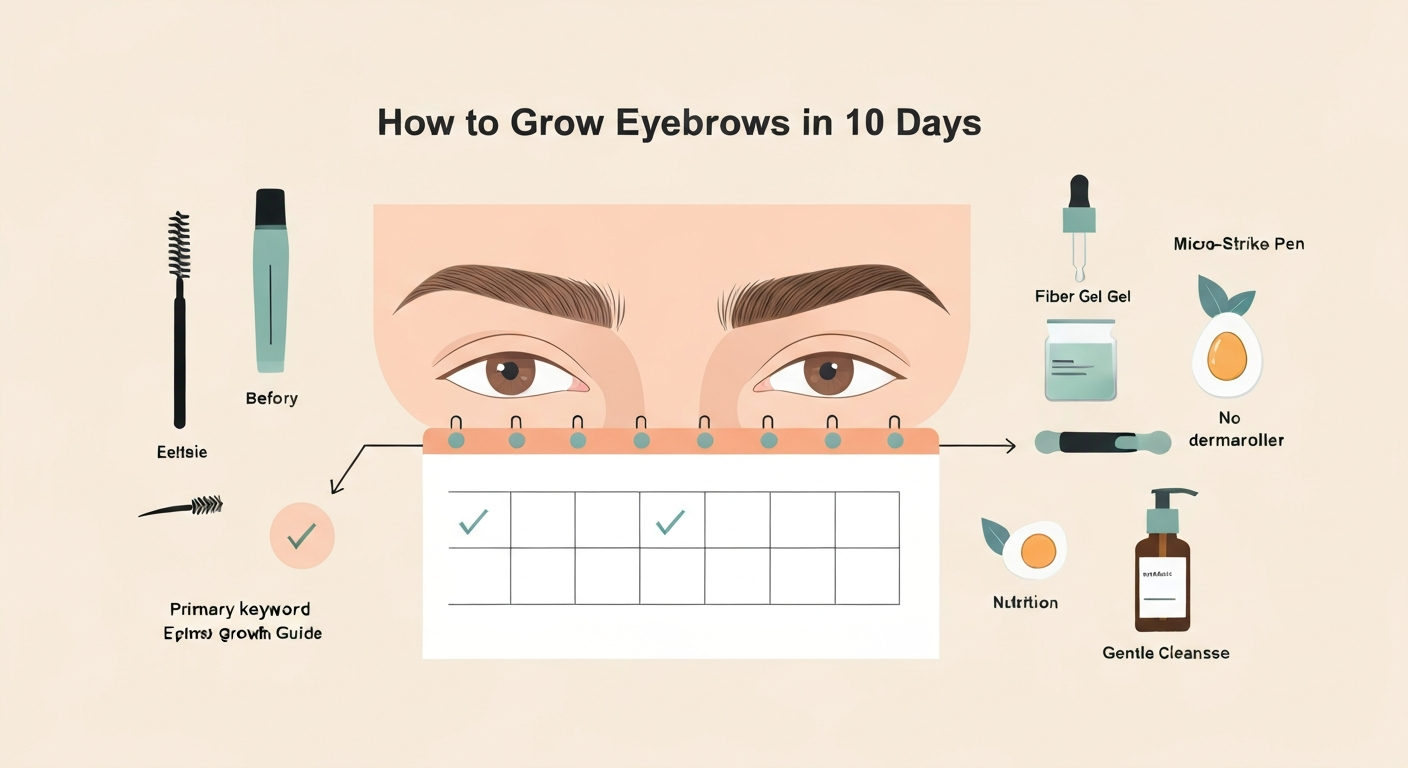
What's actually possible in 10 days (versus those 1–3 day claims)
I understand the frustration when you see articles promising full brow regrowth in 48 hours. Those claims ignore basic hair biology, and following them will only leave you disappointed. Related reading: how to grow eyebrows fast in 2 days. Here's the honest timeline based on how eyebrow follicles actually work. If you're searching for 'how to grow eyebrows in 1 day', that claim is misleading, read on for why rapid fixes don't work and what safe, realistic alternatives exist.
Eyebrow hairs cycle through three phases: anagen (active growth, about 2 to 3 months for brows), catagen (regression, 2 to 3 weeks), and telogen (resting, another 2 to 3 months). This is a much shorter anagen window than scalp hair, which is why brow hairs cap out at a limited length and why so many follicles are resting at any given time. When a hair is removed or falls out, the follicle has to complete its current phase before new growth begins. You cannot shortcut that biology with any oil or serum.
| Timeframe | What's biologically possible | What you can realistically see |
|---|---|---|
| 1 day | Zero new hair growth | Better-looking brows through cosmetics only |
| 2–3 days | Zero new hair growth | Cosmetic improvement; scalp/skin inflammation starting to subside post-wax |
| 10 days | Possibly 1–2 mm of growth in follicles that were already in mid-anagen | Faint new hair stubs in some areas if shaved recently; noticeable improvement with consistent cosmetic use |
| 1 month | Visible baby hairs in responsive follicles; early results from topicals | Measurable improvement in density for many people; fuller appearance with continued cosmetic help |
| 3–4 months | Full growth cycle results from topicals like minoxidil or rosemary oil | Genuine density and length gains in good responders |
If you're comparing these timelines to other articles in this space, the biology is the same whether the headline says 1 day, 3 days, or 10 days. The honest difference is that 10 days is enough time to build a real routine, see whether your skin tolerates your chosen topicals, and notice the earliest regrowth stubs if you shaved recently. It's the beginning of a meaningful process, not the end of it.
Quick dos and don'ts for safe, faster regrowth
Before you open any oil or pick up any tool, these are the non-negotiables. Breaking any of the don'ts will actively slow regrowth or cause damage you'll be managing for months.
- DO keep your hands away from your brows — touching transfers bacteria and disrupts fragile new growth
- DO clean the brow area gently morning and night with a mild, fragrance-free cleanser
- DO apply your chosen topical (see the topicals section below) consistently — skipping days kills the cumulative effect
- DO patch test every new product on your inner arm for 24 hours before applying anywhere near your eyes
- DO eat enough protein — your hair is made of keratin, and deficiency genuinely slows growth
- DON'T wax, thread, or pluck any hairs for the full 10 days, including strays
- DON'T apply products directly to the eyelid or waterline — the skin there is extremely thin and products migrate
- DON'T use multiple active topicals at the same time when you're just starting — introduce one at a time
- DON'T use castor oil or rosemary oil undiluted near the eye — always dilute and apply with a clean spoolie
- DON'T expect 10 days to reverse months or years of thinning — this is the start of the plan, not the finish line
Immediate cosmetic tactics: look better in 1–3 days while waiting for real growth
While your follicles work on their own schedule, cosmetics close the gap between where your brows are and where you want them. Done well, these techniques are genuinely convincing and won't interfere with regrowth. For a quick-start cosmetic and care checklist geared toward rapid short-term improvement, see how to grow eyebrows in 3 days (internal reference: 77b3250f-ee83-420d-85f1-da2c6c3d61e2).
Tinting
If your brows are light or patchy, a professional or at-home tint is the single highest-impact 30-minute change you can make. Tinting darkens both the existing hair and the fine vellus hairs you might not have noticed, making your brows look significantly fuller with zero product needed afterward. A salon tint lasts 3 to 6 weeks. At-home kits (brands like Godefroy or RefectoCil) work well if you follow the instructions carefully and do a patch test first. Avoid tinting if your skin is currently irritated from a recent wax.
Brow pencils and micro-stroke pens
A micro-stroke brow pen (sometimes called a hair-stroke pencil) has an ultra-fine tip that draws individual hair-like lines rather than filling in solid color. Brands like Anastasia Beverly Hills Brow Wiz or NYX Micro Brow Pencil are widely available. The key is to use light, short strokes that follow the natural direction of your existing hairs. Match the pencil to your hair color, or go one shade lighter for a more natural finish. Fill sparse areas in the direction of growth, then brush through with a spoolie to soften.
Brow powders and pomades
Powder gives a softer, more diffuse fill that works especially well for sparse brow tails or large gaps. Use an angled brush and apply with light pressure, layering gradually. Pomades (waxy, pigmented gels) provide the most defined and long-lasting result but require practice, if applied heavily they look drawn on. A light-handed pomade can anchor short, unruly hairs while adding density in gaps.
Brow fibers
Fiber gels or loose fiber products (like Maybelline Brow Extensions or Benefit Gimme Brow) use tiny fibers that cling to existing hairs and skin to mimic density. They're genuinely impressive for sparse brows and add textural fullness that no pencil can replicate. They are less water-resistant than pencils, so not ideal for sweaty or rainy conditions, but for day-to-day use they're worth trying.
Application order that works
- Apply a light concealer or skin-toned shadow under and around the brow to create a clean canvas
- Fill any large gaps with powder first using an angled brush — this creates the base shape
- Add micro-stroke pen lines over the powder to mimic individual hairs
- Press fibers into place if using a fiber gel, brushing upward through the arch
- Set with a clear or tinted brow gel by brushing hairs into your desired shape
- Use a concealer on a flat brush to neaten the edges for a polished finish
Your 10-day action plan: day-by-day routine
This plan assumes you're starting from scratch, whether you've recently shaved, over-plucked, or you're trying to thicken naturally sparse brows. Each day builds on the last. The morning steps take about 5 minutes; the evening steps about 10 minutes.
- Day 1 — Baseline and setup: Take a clear photo of your brows in good natural light (front and slight angle). This is your reference point. Clean your brows with a gentle cleanser. Do a patch test for whatever topical you plan to use — apply a small amount to your inner arm and leave for 24 hours. Do NOT apply any new products to your brows yet. In the morning, practice your cosmetic routine using pencil and/or fiber gel.
- Day 2 — Check patch test and introduce topical: If no redness, itching, or swelling from yesterday's patch test, you can begin your topical of choice tonight. Apply a small amount (a rice-grain-sized drop per brow) of your chosen oil or serum to the brow area using a clean spoolie or cotton swab. Keep it above the brow bone — do not let it migrate toward the eye. Continue cosmetic routine in the morning.
- Day 3 — Gentle stimulation and nutrition check: In the evening after your topical, use a clean finger to gently massage the brow area for 60 seconds per side using small circular motions. This is not proven to accelerate growth in controlled trials, but improved circulation is a reasonable supporting habit and it costs nothing. Audit your diet: are you eating enough protein (aim for at least 50 g daily), iron-rich foods, and biotin-containing foods like eggs? Deficiency genuinely slows hair growth.
- Day 4 — Consistency check: You should now be 2 full applications into your topical. Note any skin reaction (redness, dryness, itching). If your skin feels irritated, take a night off and apply a fragrance-free moisturizer instead. Continue the massage and morning cosmetic routine.
- Day 5 — Consider microneedling prep (optional): If you plan to add microneedling to your routine, tonight is a good night to read through the microneedling section below and order a 0.25–0.5 mm dermaroller if you don't already have one. Do not microneedle yet — wait until Day 7 to give your skin time to adjust to the topical first. Continue topical and massage.
- Day 6 — Midpoint check-in: Take a second photo and compare to Day 1. You will not see new hair growth yet — but check whether your skin looks calmer and healthier, and note whether your cosmetic routine is improving. Adjust your cosmetic technique if needed. Continue evening routine.
- Day 7 — Optional first microneedling session: If using a dermaroller (0.25–0.5 mm only for the brow area), cleanse the brow area thoroughly, roll gently 4 to 5 times in horizontal, vertical, and diagonal directions without pressing hard. Apply your topical immediately after — this is when absorption is highest. Your skin will look mildly pink for 30 to 60 minutes; this is normal. Skip the massage tonight since microneedling already provides stimulation.
- Day 8 — Post-microneedling recovery: Give your skin a rest from microneedling. Apply your topical as normal tonight. Watch for any prolonged redness, swelling, or breakouts from yesterday's session. If all is well, your skin should look normal by now. Some people notice a temporary 'glow' in the skin around the brows in the 24–48 hours after needling.
- Day 9 — Reinforce nutrition and lifestyle habits: Sleep, stress management, and nutrition matter more than many people realize for hair health. Chronic stress elevates cortisol, which can push hair follicles into telogen (resting) phase prematurely. If you've been skimping on sleep or eating poorly this week, tonight commit to 7 to 8 hours of sleep and a protein-rich breakfast tomorrow.
- Day 10 — Final photo and reassessment: Take your third photo in the same lighting and angle as Day 1. Compare all three. If you shaved recently and had hairs in mid-anagen, you may see short stubs or very fine new growth. Your skin should be tolerating your topical well. Your cosmetic routine should be noticeably more efficient after 10 days of practice. Most importantly, you now have a working routine — the next 30 to 90 days are where real biological change happens. Stay the course.
Daily morning and evening checklist
Once the 10-day plan is complete, this condensed checklist becomes your ongoing daily routine. Print it, screenshot it, put it on your mirror, consistency is the only thing that makes any of this work.
| Time | Step | Time needed |
|---|---|---|
| Morning | Gentle cleanse of brow area | 1 min |
| Morning | Apply brow cosmetics (pencil, powder, or fiber gel) | 3–5 min |
| Morning | Eat a protein-rich breakfast (eggs, Greek yogurt, legumes) | — |
| Evening | Remove all brow makeup with a gentle oil-based cleanser or micellar water | 1 min |
| Evening | Cleanse face with mild fragrance-free cleanser | 1 min |
| Evening | Apply chosen topical (castor oil, rosemary oil, or peptide serum) with spoolie | 2 min |
| Evening | Gentle 60-second circular massage per brow | 2 min |
| Weekly (once) | Microneedling session with 0.25–0.5 mm dermaroller if using | 10 min |
| Weekly (once) | Progress photo in consistent lighting | 1 min |
Evidence-based topicals: what the science actually says
I'll be straight with you: the evidence quality varies enormously between the ingredients below. I've used several of them myself, and I've seen results, but I'm also honest that my personal experience isn't a clinical trial. Here's what the research actually supports.
Castor oil
Castor oil is the most popular brow remedy on the internet, and the evidence for it is the weakest of everything on this list. There are no high-quality randomized controlled trials showing castor oil reliably increases eyebrow or scalp hair growth. Its active compound, ricinoleic acid, does have known pharmacological activity at prostaglandin EP3 receptors, the same receptor family that some hair-growth drugs target, but that mechanism hasn't been proven to translate into follicle stimulation in humans at topical doses. What castor oil does reliably do is condition and coat the hair shaft, which makes existing hairs look thicker, shinier, and darker. That's a real, noticeable benefit, just not the same as growing new hairs. Use it if you like it; it's safe, inexpensive, and your brows will look better for it. Just don't expect it to restore severely thinned brows on its own.
How to apply: Place a tiny drop of cold-pressed castor oil on a clean spoolie or cotton swab. Brush through brow hairs in the direction of growth. Apply to the brow only, not the eyelid skin. Leave overnight. Wash off in the morning. Use nightly.
Rosemary oil
Rosemary oil has better evidence than castor oil, though it's still not eyebrow-specific. The most cited study is a head-to-head RCT comparing rosemary oil to 2% minoxidil for scalp androgenetic alopecia over 6 months, which found no significant difference in hair count between the two, encouraging for rosemary, but the key word is scalp. A 2026 double-blind trial (Rosmagain) found rosemary-based formulations improved scalp hair growth versus coconut oil over 90 days, but again these are scalp studies using combination formulas. Applying those findings directly to eyebrow follicles is an extrapolation. That said, rosemary oil is safe, anti-inflammatory, and well-tolerated by most people. It's a reasonable addition to your routine with the expectation that results (if any) will take 3 to 6 months.
How to apply: Dilute 2 to 3 drops of rosemary essential oil in a teaspoon of a carrier oil (jojoba or argan work well). Apply with a clean spoolie to the brow hairs and skin. Massage gently. Leave on overnight and cleanse in the morning. Never apply undiluted essential oil near the eyes, it will cause significant irritation.
Growth peptides
Peptide-based brow serums (typically containing compounds like myristoyl pentapeptide-17, biotinoyl tripeptide-1, or similar signal peptides) sit in a middle ground between anecdote and solid clinical evidence. Some brand-funded studies show improvement in brow density, but independent, high-quality RCTs are limited. Peptide serums are generally well-tolerated, non-irritating, and safe for periorbital skin, which gives them an advantage over some stronger actives. If you want to start somewhere safe and effective-feeling with low risk of side effects, a peptide serum is a good first choice. Results appear gradually over 8 to 12 weeks in good responders. Popular options include Vegamour GRO Brow Serum and Revitalash Revitabrow.
How to apply: Apply with the included applicator or a clean spoolie to clean, dry brows. Most formulas are designed to be applied once nightly. Follow the product instructions for application volume, as over-applying doesn't accelerate results.
Minoxidil (off-label)
Minoxidil has the strongest evidence of any OTC topical option for actual hair regrowth on eyebrows. Controlled studies using 2% topical minoxidil have reported modest but measurable increases in eyebrow hair counts over months of use. It is not FDA-approved for eyebrow use, this is strictly off-label, but dermatologists do recommend it. However, the cautions are real and worth taking seriously. Periorbital application of minoxidil carries risks that scalp application doesn't: case reports have linked it to central serous chorioretinopathy (a type of vision problem involving fluid under the retina) and other ocular findings when used near the eyes. These events are rare but documented. Minoxidil is also Pregnancy Category C, avoid during pregnancy and breastfeeding, or discuss with your doctor first. Systemic absorption from periorbital skin is possible. Local side effects include skin irritation and the possibility of facial hypertrichosis (unwanted hair growth in adjacent areas) if the product migrates.
If you choose to try minoxidil: use 2% liquid only (not 5% foam, which is stronger and less controlled for periorbital use), apply a single small drop to each brow with a cotton swab once daily, keep it strictly on the brow, not the eyelid, and let it dry completely before sleeping. If you develop any visual symptoms (blurry vision, visual disturbances), stop immediately and see an ophthalmologist. Given the risk profile, I'd honestly recommend trying peptide serums or rosemary oil first, and reserving minoxidil for cases where those haven't worked after 3 to 4 months.
Bimatoprost (prescription only)
Bimatoprost 0.03% (the active ingredient in Latisse) has the strongest clinical evidence of anything on this list for eyebrow hypotrichosis specifically. Multiple randomized, double-masked, vehicle-controlled trials have shown statistically significant increases in eyebrow hair versus placebo. Small comparative trials have shown it performs similarly to or better than minoxidil for eyebrow enhancement. The catch: it's a prescription medication with its own risk profile, periocular skin hyperpigmentation, eye irritation, conjunctival redness, and potential for iris color change with direct ocular contact. It requires monitoring and should only be used under a dermatologist or ophthalmologist's guidance. This is worth knowing about if OTC options haven't delivered results after 4 to 6 months.
| Topical | Level of evidence for brows | Typical timeline for results | Main risks |
|---|---|---|---|
| Castor oil | Very low (anecdotal/cosmetic conditioning only) | Cosmetic improvement immediately; no proven follicle growth | Minimal — allergic contact dermatitis possible |
| Rosemary oil | Low-moderate (RCT evidence for scalp only) | 3–6 months if it works | Irritation if undiluted; not established as eyebrow-safe |
| Growth peptide serums | Low-moderate (brand studies; limited independent RCTs) | 8–12 weeks | Generally well-tolerated; low risk periorbital |
| Minoxidil 2% (off-label) | Moderate (controlled trials, not FDA-approved for brows) | 3–4 months | Ocular adverse events (rare), hypertrichosis, pregnancy warning |
| Bimatoprost 0.03% (Rx) | High (multiple RCTs, eyebrow-specific) | 2–4 months | Skin hyperpigmentation, eye irritation, iris color change risk; prescription required |
Microneedling for brows: how to do it safely at home
Microneedling creates thousands of tiny micro-injuries in the skin that trigger a controlled healing response, including collagen production and increased blood flow to the follicles. For scalp hair loss, there's systematic-review-level evidence supporting it as an adjunct treatment, especially when combined with topicals like minoxidil (which absorbs significantly better into needled skin). Evidence specific to eyebrow microneedling is limited, but practitioners do use it for this purpose and the biological rationale is sound. I've tried it on my own brows, it's not painful at the right depth, and I noticed improved product absorption almost immediately.
Choosing the right device
Needle length is everything when it comes to periorbital safety. Device/dermaroller guidance: home cosmetic/face‑area devices commonly use ≤0.5 mm needles; professional microneedling for hair/scalp often uses 0.5–1.5 mm; periorbital/eyebrow treatment generally requires shorter needles (commonly 0.25–0.5 mm at home or up to 0.5–1.0 mm in‑clinic) to reduce risk to thin eyelid skin and ocular structures (Microneedling: Advances and widening horizons - review (PMC)). Scalp protocols use 0.5 to 1.5 mm needles, but the brow area sits directly over thin eyelid skin and the orbital rim. For at-home brow microneedling, use a device with 0.25 to 0.5 mm needles only. Professional in-clinic treatments may go up to 0.5 to 1.0 mm under controlled conditions. Do not use a scalp dermaroller (which may have longer needles) on your brow area. Small brow-specific dermarollers or dermastamps designed for facial use are the right tools. Dermastamps (which press straight down rather than rolling) are actually preferred for the brow area since rolling can be harder to control on a narrow strip of skin.
Step-by-step procedure
- Sanitize your device with 70% isopropyl alcohol and let it dry completely
- Cleanse your brow area thoroughly and pat dry — no makeup, no oils, no products on the skin before needling
- If using a dermaroller: roll gently 4 to 5 times in each direction (horizontal, vertical, diagonal) over each brow; use minimal pressure — you are not scrubbing, just lightly passing the needles across the skin
- If using a dermastamp: press straight down with even, gentle pressure; lift and move slightly; repeat across the brow in a systematic pattern
- The skin should look mildly pink afterward — this is normal; significant bleeding or pain means your pressure is too heavy or your needles are too long
- Immediately apply your chosen topical (castor oil, rosemary oil, peptide serum, or minoxidil) — absorption is substantially higher in the first 20 minutes after needling
- Do not apply retinoids, acids, or vitamin C to the brow area for 24 hours after needling
- Clean and re-sanitize your device after use; replace it every 4 to 6 sessions or when needles feel blunt
Frequency and cautions
For at-home use with 0.25 to 0.5 mm needles, once a week is the right frequency for the brow area. The skin around the eyes is thinner and more delicate than the scalp, so it needs more recovery time between sessions. Do not microneedle over active breakouts, rashes, eczema, psoriasis, or any skin infection. If you have a history of keloid scarring, check with a dermatologist before starting. Avoid microneedling if you're on blood thinners or isotretinoin. If you experience prolonged redness beyond 24 hours, swelling, or any signs of infection (warmth, pus, increasing pain), stop and see a doctor.
Nutrition and lifestyle: the unglamorous side of brow growth
No topical can compensate for a body that's under-resourced. Hair is built from keratin protein, and your follicles are some of the most metabolically active cells in your body. They're among the first to be affected by nutritional deficiency, chronic stress, or poor sleep. If you're doing everything right topically and still seeing slow progress, look here first.
- Protein: aim for at least 50 g daily (ideally more if you're active); eggs, fish, chicken, legumes, and Greek yogurt are efficient sources; hair is literally made of protein, so deficiency is a direct limiting factor
- Iron: low ferritin (iron stores) is a well-documented contributor to hair loss — if you've had blood work recently showing low ferritin, supplementing under medical guidance can make a real difference
- Biotin: while biotin deficiency causes hair loss and supplementation corrects deficiency, taking extra biotin above your needs has not been shown to accelerate growth in people who are not deficient; most Western diets provide adequate biotin
- Zinc: another documented contributor to hair loss when deficient — found in meat, shellfish (especially oysters), nuts, and seeds
- Omega-3 fatty acids: found in oily fish, walnuts, and flaxseed; support a healthy scalp and may reduce follicle inflammation
- Sleep: aim for 7 to 8 hours — growth hormone, which supports tissue repair and hair growth, is primarily secreted during deep sleep
- Stress management: chronically elevated cortisol can shift follicles into the telogen (resting) phase; exercise, meditation, and adequate rest all help modulate this
Safety, side effects, and who should talk to a doctor first
Most of the remedies in this guide are low-risk when used as described, but periorbital skin is not the same as the rest of your face. A few situations where you should consult a doctor before starting any brow regrowth regimen:
- Pregnancy or breastfeeding: minoxidil is Pregnancy Category C and should not be used without medical guidance; bimatoprost also carries restrictions; even essential oils are worth discussing with your OB
- History of eye conditions: glaucoma, retinal issues, or any chronic eye condition makes periorbital drug use higher risk — discuss with your ophthalmologist before using minoxidil or bimatoprost near the eye
- Autoimmune conditions: brow loss from alopecia areata or thyroid disease requires medical diagnosis and targeted treatment; topical oils won't address the underlying cause
- Medications: blood thinners, immunosuppressants, or isotretinoin all affect how your skin responds to microneedling or topicals — check with your doctor
- Skin conditions: active eczema, psoriasis, or seborrheic dermatitis in the brow area means you need to treat the skin condition first
- Visual symptoms after using any periorbital product: blurry vision, visual disturbances, or eye pain require immediate medical attention — stop the product and see a doctor
Patch testing is non-negotiable for every new product. Apply a small amount to your inner arm and wait 24 hours before using it near your eyes. This is especially important for essential oils, which are common contact allergens even when diluted.
When to see a dermatologist and what professional options exist
If you've done a consistent 3 to 4 month run of evidence-based topicals with no improvement, it's time to involve a professional. Persistent brow thinning can reflect hormonal changes (thyroid dysfunction, low estrogen, or androgen imbalance), nutritional deficiency, alopecia areata, or medication side effects, all of which a dermatologist can investigate with bloodwork and a physical exam.
Professional options worth discussing include prescription bimatoprost or compounded minoxidil formulations with better periorbital safety profiles. PRP (platelet-rich plasma) injections into the brow area are an emerging option, at least one randomized clinical trial has been registered to study PRP specifically for eyebrow hypotrichosis, though the evidence is still building. For permanent or semi-permanent cosmetic solutions, microblading provides realistic-looking hair-stroke pigmentation that lasts 12 to 18 months and is particularly useful while waiting for biological regrowth. For severe, long-term cases, eyebrow transplants (using follicular unit grafts from scalp or nape hair) offer a permanent solution but require significant recovery and expertise. These are last-resort options, but they exist and they work.
The realistic bottom line
Ten days is enough time to build the right habits, start the topicals that compound over months, and dramatically improve how your brows look today with good cosmetic technique. It's not enough time to grow new hairs, but if you do everything in this plan consistently for the next 30 to 90 days, the growth that starts tonight will be visible, measurable, and worth it. For a focused month-long routine with day-by-day steps, see our guide on how to grow eyebrows in a month. I've been through this process myself, and the hardest part is always the patience. Start tonight, track your progress, and give the biology the time it actually needs.
FAQ
Title and meta description
Title: How to Grow Eyebrows in 10 Days — Fast, Realistic Improvement Plan Meta description: Realistic 10‑day eyebrow plan: safe daily checklist, immediate cosmetic fixes, evidence‑based topicals, microneedling tips, and safety notes.
Short answer — can you grow eyebrows in 10 days?
Short answer: You can produce noticeable cosmetic improvement in 1–3 days using makeup/tinting and expect early baby‑hair regrowth or improved thickness signals within 7–10 days for some people, but biologic hair growth cycles mean true, durable increases in eyebrow length and full density usually take weeks to months (often 4–12 weeks or longer). Claims of full regrowth in 1–3 days are not supported by hair‑cycle physiology.
10‑day action plan (daily checklist) — overview
Daily checklist (detailed day‑by‑day below): 1) Avoid further plucking/shaving; 2) gentle cleansing and moisturising of brow skin; 3) nightly application of chosen evidence‑based topical (castor/rosemary/peptide/minoxidil/bimatoprost with cautions); 4) gentle daily massage (30–60 seconds) to stimulate circulation; 5) protective grooming (brush, trim only when necessary); 6) nutrition and sleep focus; 7) cosmetic camouflage as needed; 8) microneedling only on scheduled days with proper technique.
Day‑by‑day 10‑day checklist (concise)
Day 1: Stop plucking/shaving. Clean brows, apply topical (see product notes), start 30–60s daily massage. Use eyebrow pencil/tint/fibers for immediate appearance. Check patch test results. Day 2: Continue nightly topical, massage, gentle cleansing AM/PM. Consider eyebrow tint or pencil for daytime. Hydrating serum or light oil at night if tolerated. Day 3: Continue routine. If using castor or rosemary oil and patch test is clear, apply at night. Use grooming spoolie each AM. Day 4: Reassess skin for irritation. If using home microneedling, perform single shallow pass (0.25–0.5 mm) this evening only if you are experienced and patch was fine; otherwise defer to clinic. Day 5: Continue topical and massage. Add biotin‑rich foods or supplement if dietary intake low (see safety). Maintain sleep/hydration. Day 6: Continue. Use eyebrow powder/fiber in AM for fullness. If using minoxidil off‑label, apply as prescribed with extreme caution (see warnings). Day 7: Evaluate progress photographically (same lighting). If no irritation, continue plan. Consider professional tint/lamination appointment for immediate thicker look. Day 8: Repeat nightly topical; if using medical topicals (bimatoprost/minoxidil), keep consistent timing. Avoid new cosmetics/skin products. Day 9: Gentle trim only if long unruly hairs are present — avoid shortening visible hairs too much. Continue makeup camouflage. Day 10: Take comparison photos. Continue evidence‑based regimen beyond Day 10 for true regrowth; expect incremental improvements over weeks.
Immediate cosmetic tactics for visible results in 1–3 days
Options that give fast visual improvement: eyebrow tinting (semi‑permanent dye) — 2–30 days color; pencils and powders — instant shaping and density; brow fibers/fibergel — instant illusion of thicker hair; tinted brow gel or lamination for shape and lift. Use hypoallergenic products near eyes; remove before sleep. These are cosmetic, not biologic regrowth.
Nutrition and lifestyle steps to support faster regrowth
Eat a balanced diet rich in protein, iron, zinc, vitamins A, C, D, and B vitamins (especially biotin if deficient). Prioritize 7–9 hours sleep, avoid smoking, limit alcohol, manage stress (stress can trigger telogen effluvium). If you suspect deficiency, check labs (CBC, ferritin, TSH, vitamin D) with your clinician before supplementing high doses.
How to Grow Eyebrows in 1 Day: Fast Fixes & Realistic Plan
How to grow eyebrows in 1 day: realistic verdict, same-day fixes, timelines, treatments and safe routines.