For most people, yes, eyebrow hair does grow back after an eyebrow piercing, as long as the piercing was placed cleanly, healed without serious infection, and the underlying follicles were not deeply destroyed. After a laceration that needed stitches, regrowth is also possible, but the outcome depends more heavily on how deep the cut went and how well the wound healed. The honest answer is that most cases resolve well, some cases leave a small bald patch, and a minority end up with permanent follicle loss, and there are real, evidence-based things you can do to tilt the odds in your favor.
Does Eyebrow Hair Grow Back After Piercing or Stitches?
James Whitmore
13 Aug 2026
What this guide actually covers
This guide addresses two distinct situations that get lumped together: eyebrow piercings (a deliberate surface perforation through brow tissue) and eyebrow lacerations that were closed with sutures (stitches after an accidental cut or surgical incision). The biology of hair loss is similar in both cases, but the risk profile is different. A standard eyebrow piercing needle passes through skin and subcutaneous tissue at a controlled depth, usually 6–8 mm below the skin surface. A deep laceration from a fall, car accident, or surgical procedure can cut through tissue at any angle and any depth, sometimes well past the follicle bulbs. I will walk through the biology, typical timelines, red flags for permanent loss, and the regrowth options that actually have evidence behind them.
Eyebrow hair biology 101: follicles, growth cycles, and what regrowth really means
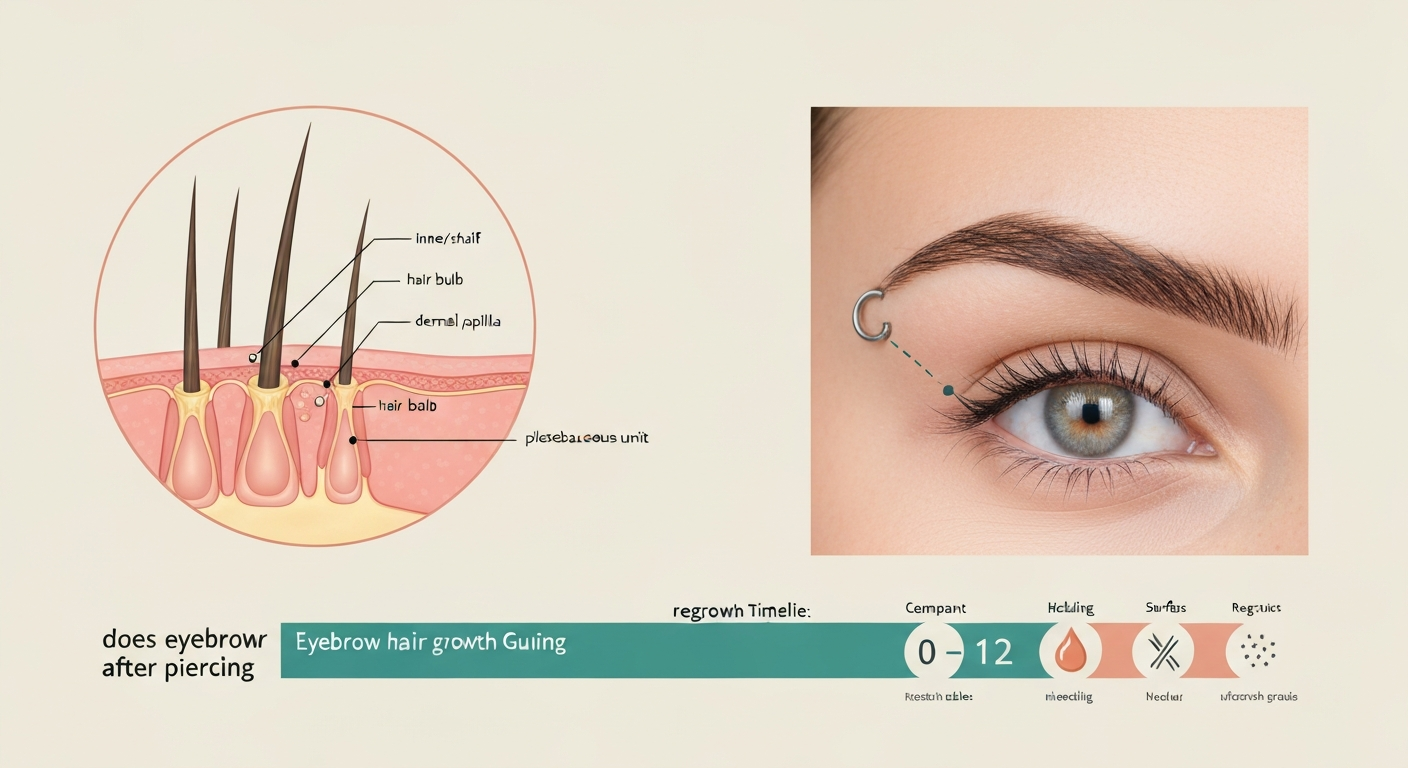
Eyebrow hairs grow from pilosebaceous units, the same basic follicle structure found everywhere on the body, consisting of an outer root sheath, an inner root sheath, a hair bulb at the base, and a dermal papilla sitting inside that bulb. The dermal papilla is the command center: it contains the signaling cells (dermal papilla cells) that drive hair matrix cell proliferation. When a follicle is injured, whether it recovers depends almost entirely on whether that dermal papilla survives.
What makes eyebrow follicles different from scalp follicles is not anatomy, it is timing. Eyebrow hair has a much shorter anagen (active growth) phase of roughly 2 to 3 months, compared to the 2 to 6 years you get on the scalp. Catagen (transition) lasts about 2 to 3 weeks, and telogen (resting/shedding) lasts another 2 to 3 months. That short anagen window is why eyebrow hairs never grow past a certain length on their own, and it also means follicle turnover is faster, which is actually helpful when we are talking about trauma recovery, because resting follicles can be recruited back into activity sooner.
When we say hair 'grows back,' we mean a follicle that was temporarily disrupted, pushed into telogen by trauma, mechanical pressure, or local inflammation, re-enters anagen and produces a new hair shaft. This is categorically different from a follicle that has been physically destroyed and replaced by fibrous scar tissue. The first situation is reversible. The second is not, at least not without intervention.
How eyebrow piercings affect follicles and what usually happens
A standard eyebrow piercing is placed as a surface piercing, typically at the outer third of the brow, with the needle passing through a fold of skin at an angle roughly parallel to the brow line. The needle does mechanically displace or sever a small number of follicles along its path, there is no way around that. However, because the needle is thin (usually 16 or 14 gauge, which is 1.2–1.6 mm in diameter) and the entry and exit points are small, the total follicle count affected is low.
What I hear most often, and what community reports consistently reflect, is temporary localized shedding around the piercing site for the first few weeks to a couple of months. This makes biological sense: trauma to the skin and surrounding tissue can push nearby follicles into telogen prematurely, which is essentially the same mechanism behind telogen effluvium after surgery or illness. Those follicles are not destroyed, they have just hit pause. Most people report noticing fine regrowth at the piercing site once the piercing has healed and any local inflammation has resolved.
The risk escalates when things go wrong. Surveys of piercing complications consistently list local infection, migration, and rejection among the most common adverse events for facial piercings including eyebrow piercings. An infected piercing means prolonged inflammation, bacterial toxins (typically Staphylococcus or Streptococcus species), and swelling pressing on follicles for weeks, all of which can cause follicular scarring. A piercing that migrates or rejects drags the jewelry slowly through tissue, cutting a wider path than the original needle did and generating ongoing trauma. In those cases, the resulting scar can permanently eliminate hair in that stripe of skin.
How cuts and stitches can damage follicles and cause scarring
A laceration that required sutures is a different mechanical injury. The cut itself, whether from broken glass, a fall, or a surgical scalpel, can transect follicles at any depth. Research on follicle transection is actually quite instructive here: whether a cut follicle can regenerate depends on where the cut happened. A superficial transection, one that cuts the upper third of the follicle but leaves the bulb and dermal papilla intact, often allows regrowth, sometimes of a slightly thinner hair. A deep transection that removes or destroys the dermal papilla generally prevents regrowth because the signaling center is gone.
Suture technique matters more than most people realize. Surgical guidance for head and face lacerations emphasizes cutting between follicles rather than through them, using fine sutures (often 5-0 or 6-0 on the face), and closing under minimal tension to reduce the width of the resulting scar. A wound closed with careful alignment and minimal dead space heals with a narrow, often barely visible scar where hairs can re-emerge alongside it. A wound closed under too much tension, or with significant tissue loss, heals with a wider, denser scar that is more likely to obliterate follicles along its entire length. Beveled or trichophytic incision techniques, where the blade is angled so that follicles undercut the scar edge, are specifically used in hair-bearing skin to allow hairs to grow through the scar line rather than stopping at it.
Infection after laceration repair is the other major risk. An infected facial wound can turn a clean, well-apposed scar into a wide, inflamed, and ultimately fibrotic one. A review titled 'Factors Affecting Wound Healing (review)' notes that infection, smoking, diabetes, older age, and poor nutrition increase the risk of impaired healing and abnormal scarring that can destroy appendages, including hair follicles. Fibrosis replacing follicular structures is the hallmark of cicatricial (scarring) alopecia, and at that point, spontaneous regrowth is unlikely without intervention.
Realistic timelines: what to expect and when
Timelines for regrowth after trauma follow a predictable biological course, assuming the follicles are not permanently damaged. Trauma-induced shedding (the telogen effluvium pattern) typically begins about 2 to 3 months after the triggering event, so do not be alarmed if you notice increased brow shedding in month 2 or 3 after a piercing or a laceration repair. That is the telogen follicles releasing their hairs on schedule. Regrowth of new hairs usually begins within 3 to 6 months of the trigger, and cosmetically meaningful density, hairs that are long enough and pigmented enough to actually fill in the brow, generally takes 6 to 12 months.
| Scenario | Typical onset of shedding | Start of visible regrowth | Cosmetically meaningful regrowth |
|---|---|---|---|
| Uncomplicated eyebrow piercing | Weeks 2–8 post-piercing | Month 3–6 | Month 6–12 |
| Piercing with infection or rejection | Ongoing during complication | Variable; 6–12 months if follicles intact | 12+ months or incomplete |
| Clean sutured laceration (good repair) | 2–3 months post-injury | Month 3–6 | Month 6–12 |
| Sutured laceration with infection or wide scar | During/after complication | Partial or absent | Often incomplete; consider intervention |
I want to be direct about expectations here: this is not a fast process. The short anagen cycle of eyebrow hair means individual hairs grow at roughly 0.16 mm per day, about 5 mm per month. If you are waiting for hairs to fully re-emerge and reach visible length, you are looking at a minimum of 3 months before you see much, and easily 9 to 12 months before you can truly assess the final result. Patience is not optional.
Factors that reduce or prevent regrowth
Not every bald patch after a piercing or laceration will fill back in, and several specific factors raise the risk of incomplete or absent regrowth. Understanding them helps you assess your own situation honestly.
- Direct follicle destruction: A needle, blade, or wire that physically transected the follicle at or below the dermal papilla eliminates the regrowth signal at the source. This is the most common reason for a permanent bald spot.
- Deep scarring and fibrosis: Dense scar tissue physically replaces follicular structures, compressing or obliterating them. Wide, raised, or hypertrophic scars carry a higher risk of this than flat, narrow ones.
- Infection: Prolonged bacterial infection causes sustained inflammation that destroys follicular epithelium and accelerates replacement by fibrous tissue. An infected piercing or sutured wound that drains for weeks significantly raises the risk of cicatricial (permanent) hair loss.
- Smoking: Smoking impairs microvascular circulation and delays wound healing, increasing the risk of poor scar formation. The systemic evidence connecting smoking to impaired wound healing and abnormal scarring is well-established.
- Older age: Follicle density and regenerative capacity naturally decline with age. Older skin also tends to heal with more fibrosis. This does not mean older adults cannot recover brow hair — it means the odds are slightly less favorable.
- Medications: Systemic corticosteroids, certain immunosuppressants, anticoagulants, and chemotherapy agents can interfere with wound healing and follicle cycling. If you are on any of these, discuss the implications with your prescribing doctor.
- Nutritional deficiencies: Suboptimal protein, iron, biotin, zinc, or vitamin D can extend telogen and delay regrowth. These are worth checking, especially if overall brow density has been declining.
- Chronic mechanical trauma: Ongoing migration or rejection of a piercing, or repeated picking and trauma to a healing wound, keeps inflammation active and gives follicles no opportunity to rest and re-enter anagen.
Clear signs that hair loss may be permanent
There are clinical signs that distinguish reversible (non-scarring) hair loss from permanent (cicatricial) hair loss, and knowing them helps you decide when to stop waiting and start seeking professional evaluation.
The most reliable clinical indicator is the absence of follicular ostia, the tiny pore-like openings on the skin surface from which hairs emerge. On dermoscopy (a magnified skin examination tool used by dermatologists), loss of follicular openings in the affected area, with the skin appearing smooth and featureless, is the hallmark of cicatricial alopecia. When follicles are merely dormant or in telogen, the ostia are still present even though no visible hair shaft is emerging. When follicles have been destroyed and replaced by scar tissue, those openings disappear. This finding reliably predicts poor spontaneous regrowth and is often used to guide whether a biopsy is needed for confirmation.
- No visible hair regrowth whatsoever at 12 months after the injury or piercing removal, despite the scar appearing stable and non-inflamed
- The skin over the bare patch looks unusually smooth, shiny, or tight, without the slight texture of normal pore-containing skin
- A biopsy (if performed) shows dense fibrous replacement of follicular structures and absence of sebaceous glands — this is the histologic definition of cicatricial alopecia
- The bald area is growing rather than shrinking over time, suggesting ongoing follicle destruction rather than simple dormancy
- A dermatologist confirms absent follicular ostia on dermoscopy in the affected area
If you are past the 12-month mark with no visible regrowth in a stable, healed scar, it is worth seeing a dermatologist rather than continuing to wait. Earlier evaluation, around the 6-month mark, makes sense if you also had a significant infection or if the original wound was deep and wide. I would not spend another year applying oils to skin that has already scarred over; get a professional assessment first so you know what you are actually working with.
Evidence-based options to encourage regrowth
If follicles are intact but dormant, which is the situation for most uncomplicated piercings and clean lacerations, there are real options that can accelerate and improve regrowth. These range from basic wound aftercare through clinically validated topicals to more involved procedures. Here is how I would approach them in order.
Step 1: Protect the healing environment first
Nothing fancy beats basic wound care for preserving the follicles you still have. For an active piercing, keep the site clean with sterile saline spray (not alcohol, not hydrogen peroxide, both are too harsh for healing tissue), avoid touching or rotating the jewelry unnecessarily, and watch for signs of infection: increasing redness, warmth, purulent discharge, or spreading swelling. For a sutured laceration, follow your surgeon's aftercare instructions, keep the wound moist with a simple ointment like petrolatum-based products to reduce scab formation, and protect the area from sun exposure once the sutures are out, UV exposure to healing wounds increases pigmentation irregularity and, in some cases, local inflammation.
Step 2: Topical minoxidil, the strongest evidence
Topical minoxidil is the most evidence-supported topical option for eyebrow hair regrowth. Randomized controlled trials, including a 2023 split-face trial comparing 2% topical minoxidil to bimatoprost, have demonstrated that 2% minoxidil increases eyebrow hair density in people with eyebrow hypotrichosis, with measurable improvements typically seen within 12 to 16 weeks of consistent twice-daily application. Minoxidil works by prolonging anagen and by promoting follicle recruitment from telogen back into active growth, which is exactly the mechanism relevant after trauma-induced telogen shedding.
The practical caveats: apply it only to fully healed skin, never to an open piercing wound or a fresh suture line. Use a small amount (a few drops or a thin layer of foam) targeted to the brow area specifically, and avoid getting it in your eyes. Initial shedding in the first 2 to 4 weeks after starting minoxidil (a 'dread shed' effect) is a known and normal phenomenon. If you stop using it, hairs that were maintained by minoxidil may shed again over the following months. Talk to a dermatologist before starting if you have cardiovascular conditions or are pregnant.
Step 3: Topical oils, castor and rosemary
I get asked about castor oil and rosemary oil constantly, so let me be honest about where the evidence actually sits. Castor oil (particularly cold-pressed Ricinus communis seed oil) is rich in ricinoleic acid, has demonstrated anti-inflammatory properties in vitro, and is widely used for eyebrow growth. However, there are no published randomized controlled trials specifically demonstrating that castor oil increases eyebrow hair count or density. What we have is biological plausibility (anti-inflammatory effects could reduce follicle-suppressing inflammation), anecdotal reports, and a long history of traditional use. It is very safe to use on healed skin, and it may help, but it will not undo scarring, and it should not be your primary plan if real follicle damage has occurred.
Rosemary oil has more emerging research behind it than castor oil, with at least one clinical trial showing that 2% rosemary oil performed comparably to 2% minoxidil for scalp hair regrowth (though in the context of androgenetic alopecia, not trauma-related loss). The proposed mechanism involves inhibition of 5-alpha reductase and improvement of scalp circulation. Again, this is scalp evidence being extrapolated to eyebrows, which is not unreasonable biologically but is not proven in brow-specific trials. If you want to use it, dilute essential-grade rosemary oil to about 2% in a carrier oil (10 drops per tablespoon of carrier) and apply to healed brow skin nightly. Expect to assess results at 12 to 16 weeks minimum.
Step 4: PRP, promising but with limitations
Platelet-rich plasma (PRP) therapy involves drawing the patient's own blood, concentrating the platelet-containing fraction by centrifugation, and injecting it into the area of hair loss. The rationale is that platelets release growth factors (including PDGF, VEGF, and IGF-1) that can stimulate follicle activity. PRP has a growing evidence base for androgenetic alopecia and alopecia areata on the scalp, and some dermatologists use it off-label for eyebrow regrowth, including post-trauma cases. The limitations are real: PRP protocols vary enormously between clinics, the eyebrow-specific evidence base is still thin, and it requires multiple sessions (typically 3 to 4 initial treatments, one month apart) with variable results. If you are at the point where minoxidil and lifestyle measures have not produced enough regrowth after 6 to 12 months, PRP is a reasonable next step to discuss with a board-certified dermatologist or hair specialist.
When regrowth is not happening: hair transplant and micropigmentation
For confirmed permanent follicle loss, scarring alopecia verified by dermoscopy or biopsy, topical treatments will not work because there are no live follicles to stimulate. In those cases, two options are worth knowing about. Eyebrow hair transplantation (FUE or FUT of individual follicular units from the scalp or nape) is the most permanent solution and, in skilled hands, produces natural-looking results. It requires a surgeon experienced in brow reconstruction because eyebrow hairs grow at a precise angle and direction that must be replicated. The grafted hairs will initially grow like scalp hair (longer, faster) and will need periodic trimming. Scalp micropigmentation or cosmetic tattooing by an experienced practitioner can also create a convincing cosmetic brow while you wait for regrowth, or as a permanent solution if transplant is not viable. Case reports and adverse‑event series document that eyebrow tattooing/microblading and infected permanent‑makeup procedures have in rare cases led to delayed scarring and localized eyebrow hair loss (scarring/alopecia) Case reports and adverse‑event series document that eyebrow tattooing/microblading and infected permanent‑makeup procedures have in rare cases led to delayed scarring and localized eyebrow hair loss (scarring/alopecia)..
Cosmetic camouflage while you wait
Living with a bald patch for 6 to 12 months is genuinely frustrating, and there is no shame in using cosmetics in the interim. For specific guidance on recovering from a bad eyebrow wax and how long eyebrow hair takes to grow back, see the related guide on that topic how long eyebrow hair takes to grow back after a bad wax. Tinted brow gels, fine-tip brow pencils, and powder-based brow kits can fill in sparse areas convincingly and are entirely safe over healed skin. Water-resistant formulas are useful if you are active. Avoid heavy waxing or threading over the recovering area, unnecessary trauma or tension is the last thing a healing follicle needs. If you're wondering whether eyebrows grow back after waxing, see our guide on do eyebrows grow back after waxing for timelines and care tips specific to waxing-related hair loss. If you are wondering whether to let the broader brow grow out during recovery to better assess what is coming back, that is generally a sensible approach. If you're wondering whether you should let your eyebrows grow out before waxing, see guidance on that question for timing and grooming tips should i let my eyebrows grow out before waxing. If you’re asking “should i let my eyebrows grow out,” the short answer is yes, allowing the surrounding brow to grow can give a clearer picture of natural regrowth before pursuing treatments.
Prevention: what to do before and during a piercing or after a wound
If you are planning an eyebrow piercing and have not had it done yet, a few choices significantly reduce your risk of hair loss. Go to an experienced, licensed piercer who uses sterile single-use needles (not guns) and implant-grade titanium or ASTM F136 implant-grade steel jewelry, these materials have lower rejection rates than cheap alloys. Ask the piercer about placement: a slightly different angle or position can avoid the densest part of your brow architecture. Follow the full aftercare protocol for the entire healing period, which for an eyebrow surface piercing is typically 6 to 9 months, not 6 weeks. Surface piercings are inherently more prone to migration and rejection than piercings through cartilage or lobe tissue, so monitor the area consistently.
For a sutured laceration, the most important thing you can do post-closure is keep the wound clean, keep it moist (not wet), avoid picking at scabs, protect it from UV light once sutures are removed, and report any signs of infection to your doctor promptly. If you are having a planned procedure near the eyebrow (surgery, biopsy), ask your surgeon whether brow-hair-sparing techniques like beveled closure or trichophytic incision are appropriate for your case.
When to see a dermatologist or surgeon
Some situations warrant professional evaluation sooner rather than later, and waiting too long can close off options. See a dermatologist or hair specialist if: your piercing developed a significant infection or has been migrating or rejecting; you are 6 months post-healing with no visible regrowth in the affected area; you notice the skin over the bald patch looks smooth and featureless (possible absent follicular ostia); or you want a dermoscopy evaluation to distinguish reversible shedding from cicatricial loss before committing to months of topical treatment that may not work on scarred skin. If hair transplant is eventually your goal, a plastic surgeon or dermatologic surgeon experienced in brow reconstruction is the right referral.
The short version: your action plan
- During active healing: Use proper piercing or wound aftercare. Prevent infection above all else — it is the biggest driver of permanent follicle loss.
- Months 1 to 3: Expect some shedding around the site. This is usually the telogen effluvium pattern and does not mean follicles are gone.
- Month 3 to 6: Watch for fine regrowth. If none, assess the skin surface for texture and follicular openings. Start 2% topical minoxidil on fully healed skin if you want to actively support regrowth — twice daily, consistently.
- Month 6 to 12: Use cosmetic fillers in the interim. Consider adding a topical oil (rosemary at 2% dilution or cold-pressed castor oil) as a low-risk complement to minoxidil, not a replacement.
- Past 12 months with no regrowth: Stop waiting and see a dermatologist. Dermoscopy will clarify whether follicles are recoverable. If not, discuss PRP, hair transplant, or micropigmentation.
- Throughout: Optimize nutrition (protein, iron, zinc, vitamin D), avoid smoking, and eliminate chronic mechanical trauma to the healing site.
The biology here is genuinely on your side in most cases, eyebrow follicles are resilient, the growth cycle turns over relatively quickly, and most piercings and clean lacerations do not cause the kind of deep, destructive scarring that eliminates hair permanently. But if something went wrong during healing, the sooner you get a clear picture of what you are dealing with, the more options you will have to work with.
FAQ
Does eyebrow hair usually grow back after an eyebrow piercing?
Most of the time yes — if the piercing causes only superficial trauma and heals without prolonged inflammation or infection, eyebrow follicles nearby stay intact and hair will regrow. However, if the piercing or a complication (deep infection, repeated trauma, migration) directly damages follicle bulbs or leads to scarring, regrowth can be partial or permanently lost. High‑quality medical evidence on exact risk from piercings is limited; clinical experience and case reports show that permanent loss is possible but uncommon when aftercare is good and complications are avoided.
Does eyebrow hair grow back after an eyebrow laceration that needed stitches?
It depends on depth and how the wound was repaired. Superficial lacerations that don’t transect the follicle bulb or that are repaired with careful, low‑tension, fine‑suture technique usually allow follicles to recover and hair to regrow over months. Deep transection that removes the follicle bulb or healing with dense scar formation (cicatricial change) often prevents regrowth. Surgical technique that aligns follicles and preserves hair units increases the chance of normal regrowth.
How does eyebrow hair biology affect regrowth timelines?
Eyebrow follicles have a short anagen (growth) phase (~2–3 months) and faster turnover than scalp hair. When follicles survive an injury, shedding/regrowth often follows patterns like telogen effluvium: regrowth may begin within 2–3 months and visible improvement commonly occurs over 3–12 months. If follicles are destroyed (scarring), spontaneous regrowth is unlikely regardless of timeline.
What are clear signs that eyebrow loss is likely permanent?
Key clinical signs suggesting permanent (cicatricial) loss are: an area of smooth or shiny skin without visible follicular openings (loss of follicular ostia), firm scar tissue replacing normal skin, persistent lack of regrowth after many months despite no ongoing inflammation, and biopsy or dermoscopy findings showing fibrosis and absent follicles. If you notice these, consult a dermatologist or hair‑restoration specialist for assessment.
Which factors increase the risk of reduced or permanent regrowth after piercing or stitches?
Factors that raise the risk include: deep follicle transection or tissue loss; wound infection or prolonged inflammation; hypertrophic scarring or keloid tendency; smoking; diabetes or poor nutrition; older age; certain medications (eg, chemotherapy, some immunomodulators); repeated trauma or jewelry migration; and poor wound closure technique with high tension or misaligned edges.
What immediate aftercare prevents hair damage after an eyebrow piercing or laceration repair?
For piercings: choose a professional piercer, use appropriate jewelry (surgical steel/titanium), avoid moving the jewelry, clean gently with saline, watch for signs of infection, and avoid cosmetics near the site until healed. For lacerations: follow surgical/ER instructions—thorough wound cleaning, timely closure, fine sutures, minimal tension, keep the wound protected and moist as advised, avoid smoking, control blood sugar, and follow suture‑removal timing. Early treatment of infection and minimizing tension/scar hypertrophy preserve follicles.
Next Article
Should I Let My Eyebrows Grow Out? A Practical Guide
Should I let my eyebrows grow out? Clear yes/no guide with timelines, care tips, quick fixes & when to see a pro.