Yes, red light therapy can support eyebrow growth, but it is not a guaranteed fix and it is not the strongest tool available. The evidence is strongest for scalp hair loss, with a small but promising direct eyebrow study showing a statistically significant increase in hair count after 10 weekly LED sessions. If your brows are sparse from over-plucking, age-related thinning, or a medical condition like frontal fibrosing alopecia, red light therapy is a reasonable low-risk option to add to your routine. It just works best when paired with other proven approaches, and realistic expectations matter here: you are looking at months of consistent use, not weeks.
Can Red Light Therapy Grow Eyebrows? Evidence-Based Guide
James Whitmore
20 Jul 2026
Quick verdict: does the evidence actually support it?
Low-level laser therapy (LLLT), also called photobiomodulation or red light therapy, has FDA-cleared devices for scalp hair growth, multiple randomized controlled trials behind it for androgenetic alopecia, and at least one peer-reviewed study specifically on eyebrows. That 2021 study (published in Sensors) treated 16 patients with frontal fibrosing alopecia using a 630 nm LED matrix once weekly for 10 sessions. Average eyebrow hair count rose from 132 to 152 hairs, a statistically significant result (p=0.002) with good tolerability. A completed clinical trial using the iRestore Eyebrow Device (650 nm and 940 nm LEDs) enrolled 40 women, though peer-reviewed results have not been published yet. So we have one small but solid positive study and strong mechanistic plausibility from scalp data. That is not definitive proof, but it is enough to make red light therapy worth trying, particularly if other options have not fully worked or you want to avoid medications.
How red light therapy works on hair follicles
The core mechanism involves a molecule inside your mitochondria called cytochrome c oxidase (CCO). Red and near-infrared light at the right wavelengths gets absorbed by CCO, which triggers a cascade that effectively wakes up low-activity cells. Nitric oxide that was blocking the enzyme gets released, electron transport speeds up, and cells produce more ATP. That energy surge leads to downstream signaling changes, including activation of pathways like Wnt, VEGF, and NF-kB, all of which play a role in pushing hair follicles from the resting phase (telogen) into the active growth phase (anagen).
For eyebrows specifically, this matters because follicles that have been dormant from over-plucking, hormonal shifts, or inflammation still have intact stem cell reservoirs in most cases. Red light is not regenerating destroyed follicles from scratch. It is nudging viable but sluggish follicles back into a productive cycle. That is an important distinction because it sets a ceiling on what therapy can achieve: if follicles are permanently gone, no amount of light will bring them back.
What the research actually shows (and where it falls short)
The honest summary is this: the scalp hair evidence is strong, the eyebrow-specific evidence is thin but promising. Multiple RCTs and meta-analyses have confirmed statistically significant increases in hair density for scalp androgenetic alopecia using LLLT, and several of these have enough rigor to be taken seriously. The FDA has cleared multiple helmet and cap devices based on this body of work. But nearly all of that data is from scalp hair, which has different follicle density, cycle length, and hormonal sensitivity compared to eyebrow hair. You cannot simply extrapolate one to one.
The one direct eyebrow study (the 2021 frontal fibrosing alopecia trial) is encouraging, but 16 patients is a small sample, the condition studied is a specific inflammatory type of eyebrow loss, and there was no sham control group. The iRestore trial that enrolled 40 women has not released peer-reviewed results, which is a real gap. So right now the field is in a position where the mechanism makes sense, one small trial supports it, but larger sham-controlled eyebrow-specific trials are still needed before this can be called definitively proven.
Who is most likely to see real results
Not every brow situation responds equally well, and being honest about this saves a lot of frustration. Based on what the research supports, here is how I would rank likely benefit by cause.
- Over-plucking recovery: Follicles are often still intact but dormant from repeated trauma. Red light may help accelerate the return to anagen, especially in the first 6 to 12 months after stopping plucking.
- Age-related thinning: Hormonal shifts gradually miniaturize follicles, similar to scalp androgenetic alopecia. This is the scenario most directly supported by scalp LLLT data. Expect modest improvement rather than full restoration.
- Post-shaving or waxing regrowth: Follicles are healthy and just cycling through telogen. Red light is unlikely to add much here because regrowth will happen naturally, though it may slightly shorten the timeline.
- Medical hair loss (frontal fibrosing alopecia, alopecia areata, post-illness telogen effluvium): The 2021 study specifically addressed frontal fibrosing alopecia and showed a positive result. These cases are more complex and a dermatologist should be involved, but red light is a reasonable adjunct.
- Permanent scarring alopecia or fully fibrosed follicles: Very unlikely to respond. If the follicle structure is gone, photobiomodulation cannot rebuild it.
Treatment parameters that make sense for eyebrows
The direct eyebrow LED study used 630 nm (plus or minus 5 nm) at 68 mW/cm² irradiance, delivering 37 J/cm² per session in about 9 minutes, once per week for 10 weeks. The iRestore Eyebrow Device trial used both 650 nm and 940 nm LEDs. Scalp LLLT trials have used regimens ranging from roughly 18 minutes daily at 630 to 660 nm to 25 minutes every other day at 655 nm over 16 to 24 weeks. Randomized, sham‑controlled scalp LLLT protocols in the peer‑reviewed literature include helmet/hat or cap devices delivering red light in regimens such as ~18 minutes daily (630–660 nm; 24‑week RCT) or ~25 minutes every other day (655 nm helmet; 16‑week RCT). Taken together, a reasonable eyebrow-specific protocol looks like this.
| Parameter | Recommended range for eyebrows | Notes |
|---|---|---|
| Wavelength | 630–670 nm (red) ± 800–850 nm (near-infrared optional) | The single eyebrow study used 630 nm; scalp trials cluster around 650–660 nm |
| Irradiance | 10–100 mW/cm² | The eyebrow LED study used 68 mW/cm²; stay within device specs |
| Dose per session | 4–40 J/cm² | 37 J/cm² used in the 2021 study; home devices vary widely |
| Session duration | 5–20 minutes | Depends on device output; do not exceed manufacturer guidance |
| Frequency | 3–7 sessions per week (daily or every other day) | Once-weekly clinical sessions or more frequent lower-dose home use both appear used |
| Course duration | 12–24 weeks minimum | Expect 16–24 weeks before meaningful assessment; some protocols extend to 26+ weeks |
One thing I want to be clear about: more is not better with photobiomodulation. The dose-response curve is biphasic, meaning too much light can inhibit the very cellular activity you are trying to stimulate. Follow your device's instructions rather than doubling session time to try to speed things up.
Device types and the critically important eye safety issue
This section matters more for eyebrows than for scalp use because the treatment area is directly adjacent to your eyes. Let me break down the device options and then get into safety.
Types of devices available
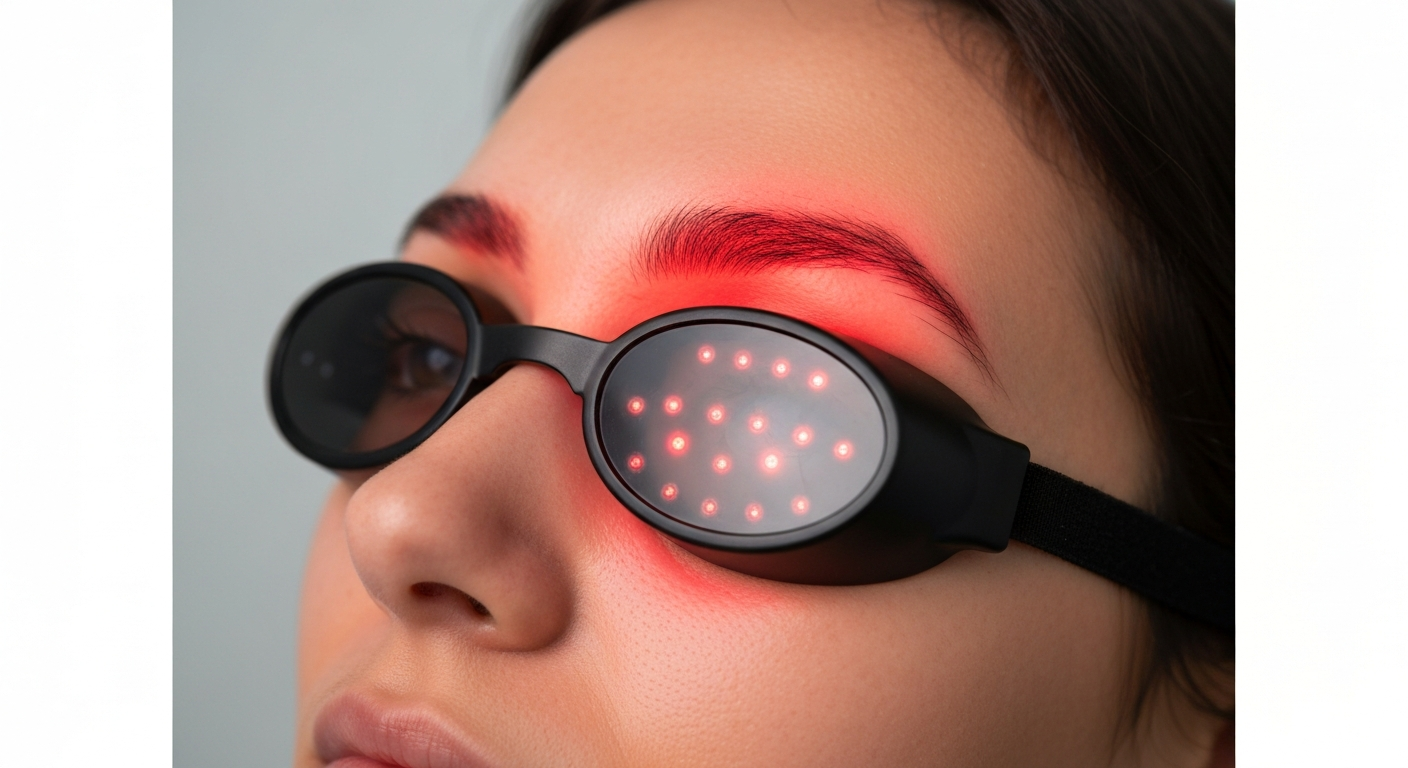
- Dedicated eyebrow LLLT devices: Headbands or wands designed specifically for periorbital use, like the iRestore Eyebrow Device. These have the most relevant geometry and are often designed with eye safety in mind, but verify the specific model's safety ratings.
- Handheld wands and pens: Spot-treatment devices you move manually over the brow area. Flexible but require you to maintain consistent distance and avoid drifting toward the eye. User compliance and consistency vary.
- Full-face or panel LED devices: Larger panels delivering red and near-infrared light to the whole face. These can cover the brow area but deliver light to the eyes too unless you use proper eye protection. Some are not designed for periorbital use at all.
- Clinical laser and LED systems: Devices used in dermatology offices, including the MEDlight LED matrix used in the 2021 FFA study. Higher power density and clinical supervision make these more precisely controlled. If you have a medical cause of brow loss, starting with a clinical assessment and in-office treatments is the smarter path.
Eye safety: this is not optional
Red and near-infrared light is not ionizing radiation and does not cause the same acute damage as UV, but that does not mean it is risk-free for the eyes. Research in ophthalmology notes that PBM has been tested in ocular applications with a low adverse event profile overall, but devices used near the eye must meet ANSI Z136 and IEC laser safety standards because some devices can approach or exceed Maximum Permissible Exposure (MPE) limits for the retina. A recent review, Photobiomodulation use in ophthalmology – an overview of translational research from bench to bedside (Frontiers / PMC), notes low overall adverse event reporting but emphasizes that devices used near the eye should meet ANSI Z136 and IEC laser safety standards because some clinical exposures can approach or exceed the Maximum Permissible Exposure (MPE) limits for the retina. The lens and retina are vulnerable to cumulative light exposure at these wavelengths.
- Always use the protective goggles supplied with your device. If your device did not include goggles rated for the wavelength it emits, do not use it near your eyes.
- Never point a handheld wand or panel directly at an open eye.
- If using a full-face panel, use blackout or wavelength-blocking eye cups, not ordinary sunglasses.
- Keep eyes closed during treatment even if you have goggles on.
- People with existing retinal conditions, recent eye surgery, or photosensitizing eye conditions should consult an ophthalmologist before using any near-eye light device.
- Children and people with light-sensitivity conditions (photophobia, certain medications) should not use periorbital red light devices without medical guidance.
Realistic timeline: what to expect and when
I will not sugarcoat this. Results take months, not weeks. Eyebrow hair cycles are roughly 4 to 6 months long, which is shorter than scalp hair but still slow enough that impatient users quit before seeing anything. In the 2021 FFA study, 10 weekly sessions (about 10 weeks) produced measurable increases in hair count. Most scalp LLLT protocols require 16 to 24 weeks before meaningful assessment. That is the honest benchmark.
| Timeframe | What you might notice |
|---|---|
| Weeks 1–4 | Likely nothing visible; cellular changes are happening beneath the surface |
| Weeks 6–10 | Some fine vellus hairs may begin appearing at the brow edges or sparse areas |
| Months 3–4 | Increased hair density may become visible; thickness and pigmentation gradually improve |
| Months 5–6 | More reliable assessment point; compare photos from baseline to now |
| After 6 months | Continue maintenance sessions (typically 1–2 per week) or results may gradually fade |
Results are not permanent. Red light therapy shifts follicles into anagen but does not change the underlying biology that caused thinning in the first place. If you stop entirely, most people see gradual regression over the following months. Maintenance sessions are part of the commitment, similar to how minoxidil requires ongoing use to preserve gains.
How red light therapy compares to other eyebrow growth options
Red light therapy does not exist in isolation. If you are serious about regrowing sparse brows, it helps to understand where it sits relative to the alternatives, including some options covered elsewhere on this site.
| Treatment | Evidence quality for eyebrows | Likely effectiveness | Main downsides | Best for |
|---|---|---|---|---|
| Red light therapy (LLLT) | 1 small direct RCT + strong scalp data | Moderate; meaningful in thinning/medical loss | Slow timeline, requires maintenance, eye safety precautions | Thinning, FFA, adjunct to other treatments |
| Topical minoxidil (Rogaine) | Split-face RCTs with significant positive results | Moderate to strong; well-studied for eyebrows | Contact dermatitis, facial hair spread, requires ongoing use | Most brow thinning causes including age-related and over-plucking |
| Bimatoprost (Latisse) | Multicenter double-masked RCT; highest evidence | Strong; FDA-approved for lash hypotrichosis | Periorbital pigmentation, cost, requires prescription | Medical hypotrichosis; works well for lash and brow thinning |
| Biotin supplements | Minimal; only proven deficient in clinical deficiency | Low for people without a deficiency | Largely ineffective unless you are deficient | Nutritional deficiency cases only |
| Nutrafol / oral supplements | Limited RCT data for hair overall; not eyebrow-specific | Potentially supportive for stress-related or nutritional loss | Cost, multiple months needed, not eyebrow-specific | Telogen effluvium, overall hair thinning |
| Revitabrow / OTC serums | Mostly cosmetic ingredient claims; limited clinical trials | Modest at best; may condition and improve appearance | Results are often cosmetic, not follicular | Mild sparseness, conditioning, appearance boost |
| PRP injections | Emerging evidence; limited eyebrow-specific data | Promising for certain types; requires clinic visits | Cost, multiple sessions, variable availability | Medical hair loss with a dermatologist's involvement |
| Microblading / transplant | Not growth treatments; cosmetic/surgical | Immediate cosmetic effect (microblading) or permanent (transplant) | Microblading fades; transplant is costly and surgical | When regrowth is not possible or desired quickly |
For most people with thinning brows, topical minoxidil and bimatoprost (Latisse) have stronger direct evidence than red light therapy. Minoxidil has split-face RCT data showing significant density improvement in eyebrows, and bimatoprost has multicenter double-masked trial evidence. If you want to learn more about those options specifically, minoxidil and Rogaine for brow growth, as well as Latisse for eyebrows, are covered separately on this site with their own evidence breakdowns. For details on whether Latisse will grow eyebrows, see our dedicated guide titled will latisse grow eyebrows that reviews the evidence and proper use. See our separate page 'Will Rogaine grow eyebrows' for a detailed evidence breakdown on minoxidil for brows. For a focused review of that product and the evidence for its claims, see our article Does Revitabrow grow eyebrows? which examines the research and user experiences. If you’re curious about supplements, see our piece on Will biotin help eyebrows grow for a summary of the evidence on biotin and other vitamins. For information on supplements, see our review titled Does Nutrafol help eyebrows grow. For detailed evidence on topical minoxidil for brows, see our can minoxidil grow eyebrows article. Red light therapy is better positioned as a complement to these treatments rather than a standalone first-line choice, especially if your thinning is significant.
Combining red light with other treatments
There is reasonable biological logic for combining LLLT with a topical growth stimulant. Red light may improve follicle receptivity to topical agents by increasing local circulation and cellular metabolism, while minoxidil or bimatoprost directly extends the anagen phase. There are no large trials confirming superior combined outcomes for eyebrows specifically, but in scalp literature, combination approaches tend to outperform monotherapy. If you are already using a topical and want to add red light, apply the topical after your light session rather than before, since light can affect how topicals are absorbed and you do not want anything on the skin interfering with device contact or creating an unexpected photosensitization reaction.
Safety, side effects, and when not to use red light therapy on your brows
Red light therapy at recommended doses has a well-established low side effect profile. In the FFA eyebrow study, tolerability was described as good. Reported adverse effects across LLLT hair literature are generally mild, including temporary scalp or skin warmth, mild erythema, and rarely headache. But there are specific situations where you should proceed with caution or not use it at all.
- Photosensitizing medications: Drugs including tetracyclines, fluoroquinolones, certain diuretics (hydrochlorothiazide), NSAIDs, antifungals, and photosensitizing biologics can increase skin and potentially retinal sensitivity to light. Check with your prescribing doctor before starting periorbital red light therapy if you are on any of these.
- History of skin cancer: LLLT has not been proven to cause skin cancer, but using light therapy over a known or suspected skin lesion is not advisable. Dermatologist clearance is recommended if you have a personal or family history of melanoma or basal/squamous cell carcinoma on the face.
- Active eye conditions: Macular degeneration, retinitis pigmentosa, glaucoma, and recent retinal surgery are all potential contraindications for periorbital light use. Consult an ophthalmologist first.
- Pregnancy: There are no specific red light therapy studies in pregnant women for eyebrow use, and LLLT is generally avoided during pregnancy as a precaution due to insufficient safety data. This is a case where the conservative choice is to wait.
- Epilepsy triggered by light (photosensitive epilepsy): Flashing or pulsed light devices may be a trigger. Avoid unless cleared by a neurologist.
- Direct eye exposure: Never use any LLLT device without appropriate eye protection. This bears repeating because the brow area is centimeters from the retina.
- When to stop and seek care: If you develop unusual skin reactions, increasing redness or swelling that does not resolve within 24 hours, any changes in vision, or new brow hair loss while using the device, stop treatment and see a dermatologist or ophthalmologist.
Practical next steps based on your situation
If you are dealing with mild to moderate eyebrow thinning from over-plucking or age-related changes and want a low-risk option to try at home, a dedicated eyebrow LLLT headband device (like the iRestore Eyebrow model) is a reasonable starting point. Budget for at least 16 to 24 weeks of consistent use, take baseline photos, and reassess at the 12-week mark. If you are not seeing any change by week 16, red light alone may not be enough for your situation.
If thinning is more significant, combining red light with minoxidil 2% or 5% applied to the brows is a practical next step. Both act on different mechanisms, the combination is biologically sound, and topical minoxidil has solid direct eyebrow RCT evidence. If you suspect a medical cause, including frontal fibrosing alopecia, alopecia areata, or thyroid-related hair loss, see a dermatologist before spending money on devices. Getting the underlying diagnosis right matters more than which device you buy.
Cost is a real consideration. Home LLLT devices designed for eyebrows run roughly $150 to $400 depending on the brand and LED count. Clinical sessions range from $50 to $150 per session or more. When you factor in the number of sessions needed, in-office treatment over 10 to 24 weeks is expensive. A quality home device may offer better long-term value if you commit to the protocol, but only buy one with documented wavelength specs (630 to 660 nm) and included eye protection.
FAQ
Can red light therapy (LLLT/photobiomodulation) grow eyebrows?
Evidence suggests red light (photobiomodulation/LLLT) can stimulate eyebrow hair growth in some situations, but most high‑quality clinical data come from scalp hair studies. Small eyebrow studies and case series show modest increases in eyebrow hair count (for example, a 2021 study in frontal fibrosing alopecia reported a statistically significant mean increase in eyebrow hairs after LED treatment). Mechanistically, PBM can shift follicles toward anagen via mitochondrial stimulation (cytochrome c oxidase), increased ATP, nitric oxide signaling and downstream growth pathways. Expect modest improvements over months, and results vary by cause of loss (better for recovering/miniaturized follicles than complete scarring/follicle destruction).
How does red light therapy work biologically to promote hair growth?
PBM at red/NIR wavelengths is absorbed by mitochondrial chromophores (notably cytochrome c oxidase), causing photodissociation of inhibitory nitric oxide, increased electron transport and ATP, and transient reactive oxygen species signaling. These events activate transcriptional pathways (eg. NF‑κB, HIF‑1, VEGF/Wnt) that increase cell proliferation, angiogenesis and shift follicles from telogen toward anagen. The effect is modulatory — it stimulates existing follicles rather than creating new ones if follicles are destroyed.
What wavelengths, doses, and session schedules have been used for eyebrow/scalp hair studies?
Studies concentrate on red (≈630–670 nm) and sometimes near‑infrared (≈780–940 nm). Effective irradiances commonly used in hair research are under ~100 mW/cm²; reported fluences vary widely (roughly 0.04–50 J/cm² in literature). Practical, evidence‑based regimens used in scalp RCTs include ~18 minutes daily (around 650–660 nm) or ~25 minutes every other day (655 nm helmets). One eyebrow LED study used 630±5 nm at 68 mW/cm², ~37 J/cm² per session, once weekly for 10 sessions. There is no single standardized eyebrow protocol; follow device manufacturer guidance that aligns with these ranges.
How long until I might see eyebrow regrowth with red light therapy?
Realistic timelines: early changes (improved hair thickness/shine) may appear in 6–12 weeks, measurable increases in hair count or density typically require 3–6 months, and maximal results often need 6–12 months. Response depends on the underlying cause (faster for telogen shedding/over‑plucking; slower or absent for scarring alopecia with follicle loss). Consistent treatment is needed; stopping therapy may allow return to baseline over months.
How effective is red light therapy for eyebrows compared with alternatives like minoxidil or bimatoprost?
Comparative evidence: bimatoprost (0.03%) and topical minoxidil (2%) have randomized, controlled trial evidence for eyebrow hypotrichosis with clinically meaningful improvements. PBM has supportive scalp RCTs and small eyebrow studies but fewer large eyebrow RCTs. Likely hierarchy for efficacy (generalized, population‑level): bimatoprost ≈ topical minoxidil ≥ PBM as monotherapies for non‑scarring eyebrow hypotrichosis — though combining PBM with a proven topical may be additive. Side‑effects differ: minoxidil can irritate and cause unwanted facial hair; bimatoprost can cause periorbital hyperpigmentation/irritation and rare iris changes if misapplied; PBM’s adverse events are uncommon but eye‑safety must be respected.
Can I combine red light therapy with topical minoxidil or bimatoprost?
Yes — combining PBM with topical therapies is commonly practiced and biologically plausible (different mechanisms: PBM is photobiological, minoxidil is a vasodilator/K⁺ channel opener, bimatoprost is a prostaglandin analog). Many clinicians recommend adding PBM to an effective topical if results are partial. When combining, apply topical products per label/doctor instructions and space timing if irritation occurs. Avoid applying topical products that contain photosensitizing ingredients immediately prior to PBM unless a clinician advises otherwise.
Next Article
Does Nutrafol Help Eyebrows Grow? What to Expect
Nutrafol helps scalp hair with nutrients, but eyebrow growth depends on cause. Get timelines, options, and next steps.